How Does the XZR Rubber Hanger Improve HVAC Vibration Control?
The XZR Rubber Hanger Vibration Isolator is designed to reduce vibration transmission and structure-borne noise in suspended HVAC equipment, mechanical ventilation systems, and industrial piping installations. It provides a flexible connection between vibrating equipment and building support structures, helping improve acoustic comfort and reduce unwanted mechanical vibration.
In commercial and industrial buildings, equipment such as air handling units, exhaust fans, and circulating water systems generates mechanical vibration during continuous operation. Without suitable isolation, these vibrations can travel through rigid suspension rods, ceiling structures, and connected mechanical systems, potentially causing noise and discomfort in occupied spaces.
The XZR rubber isolation hanger uses an NBR (Nitrile Butadiene Rubber) elastic element integrated into a steel suspension frame. When properly loaded, the rubber element deforms elastically and provides damping, helping reduce vibration transmission between the suspended equipment and its supporting structure.
The external steel housing features a powder-coated finish that helps resist corrosion in suitable indoor operating environments. Its compact construction allows integration into suspended mechanical systems where installation space is limited.
Key Structural and Performance Advantages
- NBR Rubber Damping Element: Provides elastic support, vibration damping, and resistance to oil and mechanical wear.
- Protective Steel Housing: Powder-coated surface helps protect the hanger against corrosion and environmental exposure.
- Reduced Structure-Borne Noise: Helps limit vibration transmission through suspension rods and ceiling support systems.
- Compact Suspension Configuration: Suitable for mechanical installations with limited vertical clearance.
- Flexible Installation: Can be incorporated into compatible threaded rod suspension assemblies.
- Simple Mechanical Construction: Rubber-metal structure provides vibration isolation without complex mechanical components.
- Adaptable HVAC Applications: Suitable for suspended fans, ventilation equipment, and selected mechanical piping systems.
Unlike rigid suspension brackets, rubber vibration hangers introduce an elastic interface into the equipment support system. This interface helps reduce vibration transmission when the equipment operating frequency is sufficiently above the isolator’s natural frequency.
However, the actual vibration isolation performance depends on rubber stiffness, operating load, excitation frequency, and installation conditions. Correct engineering selection remains essential, particularly for equipment operating at low rotational speeds.
Which HVAC Equipment Benefits from XZR Rubber Hanger Isolators?
The XZR anti-vibration rubber hanger is suitable for many suspended mechanical installations in commercial buildings, hospitals, hotels, shopping centers, office towers, and industrial facilities.
Suspended Air Handling and Air Conditioning Systems
Air conditioning equipment commonly contains rotating motors, fans, and other components that generate mechanical vibration during operation.
XZR rubber vibration hangers can be considered for suspension systems supporting:
- Horizontal Ceiling-Mounted Air Handling Units (AHUs)
- Concealed Fan Coil Units (FCUs)
- Ceiling-Suspended Fresh Air Handling Units
- Ducted Split Air Conditioning Indoor Units
- Compact Heat Recovery Ventilation Units (HRVs)
- Energy Recovery Ventilation Units (ERVs)
For these applications, vibration isolation hangers help reduce the transfer of mechanical vibration from the equipment casing into overhead building structures.
Industrial Fans and Mechanical Ventilation Systems
Industrial ventilation systems often operate continuously and may transmit vibration through rigid supports.
Typical equipment includes:
- Inline Centrifugal Duct Fans
- Mixed-Flow Ventilation Fans
- Ceiling-Mounted Exhaust Fans
- Cabinet-Type Supply Air Fans
- Commercial Kitchen Exhaust Duct Supports
- Industrial Fresh Air Ventilation Units
- Suspended Dust Extraction Ductwork
When designing fan suspension systems, engineers should evaluate fan operating speed, motor characteristics, equipment weight, and vibration frequency.
Flexible duct connectors may be required to prevent vibration transmission through connected ductwork.
Chilled Water and Industrial Piping Installations
Mechanical piping systems can transmit vibration generated by centrifugal pumps, water circulation equipment, and pressure fluctuations.
XZR rubber pipe isolation hangers can be considered for:
- Chilled Water Supply and Return Pipes
- Condenser Water Circulation Pipelines
- HVAC Cooling Water Distribution Systems
- Pump Discharge and Suction Pipe Supports
- Domestic Water Supply Piping
- Mechanical Room Process Water Lines
- Suspended Building Services Pipework
For pump-connected piping, the isolation design should also consider flexible rubber expansion joints, pipe guides, anchors, and thermal expansion requirements.
Rubber hangers should not be used as substitutes for properly designed structural pipe supports.
Frequently Asked Questions (FAQ)
1. What Information Is Required to Select an XZR Rubber Hanger?
Selecting an XZR rubber hanger requires information about the suspended equipment weight, number of suspension points, operating frequency, and installation configuration. Engineers should calculate the actual load supported by each hanger rather than simply dividing the total equipment weight equally when the center of gravity is offset.
Additional considerations include threaded rod dimensions, available ceiling clearance, environmental conditions, and vibration isolation requirements. These factors help determine whether the selected hanger can provide suitable elastic support while operating within its specified working load range.
2. What Is the Difference Between Rubber Hangers and Spring Vibration Hangers?
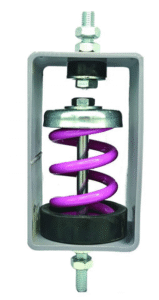
Rubber hangers use elastomeric materials to provide elastic support and damping, while spring hangers primarily use metal coil springs to achieve greater static deflection and lower natural frequencies.
Rubber hangers are commonly selected for relatively compact suspended HVAC installations where vibration frequencies are sufficiently high for effective isolation. Spring hangers are often preferred for heavier equipment or applications involving lower-frequency vibration.
The correct choice depends on operating speed, load, required isolation efficiency, and available installation space. Combined spring-rubber hangers may also be considered where both isolation and damping characteristics are important.
3. How Does Rubber Hardness Affect Vibration Isolation Performance?
Rubber hardness influences the stiffness and deformation characteristics of a vibration isolation element. In general, a softer rubber compound may provide greater deformation under a given load, while a harder compound typically offers greater resistance to compression.
However, Shore A hardness alone cannot determine vibration isolation efficiency. Rubber geometry, compound formulation, preload, temperature, and dynamic stiffness also influence performance.
For engineering selection, the relationship between supported load and static deflection should be evaluated alongside the equipment operating frequency. Excessive deformation or insufficient loading can reduce the effectiveness of the installation.
4. Can XZR Rubber Hangers Support Heavy Industrial Equipment?
The suitability of XZR rubber hangers for heavy industrial equipment depends on the rated load capacity of the specific model and the distribution of weight across the suspension points.
Equipment such as large air handling units or industrial ventilation fans may require multiple hangers with carefully calculated load distribution. Engineers must also consider dynamic forces, equipment startup conditions, and the structural capacity of the mounting system.
If the equipment exceeds the available rubber hanger load range or requires greater static deflection, alternative spring vibration isolators or specially engineered suspension systems may be more appropriate.
5. How Can Incorrect Installation Reduce Vibration Isolation Efficiency?
Incorrect installation can create rigid vibration transmission paths that bypass the rubber isolation element. For example, metal components contacting the hanger frame, misaligned suspension rods, or excessive tightening may prevent the isolator from functioning as intended.
Uneven load distribution can also cause some hangers to become overloaded while others remain insufficiently compressed.
During installation, engineers should verify correct hanger alignment, suitable working loads, adequate clearance, and secure structural anchorage. Connected piping and ductwork should also be evaluated to prevent unintended rigid connections between isolated equipment and surrounding structures.
6. Are XZR Rubber Hangers Suitable for Outdoor or High-Temperature Environments?
Standard XZR rubber hangers should be evaluated carefully before use in outdoor, high-temperature, or chemically aggressive environments. Although NBR rubber offers good resistance to many oils, its resistance to ozone, prolonged sunlight, and certain chemicals may be limited.
The powder-coated steel housing provides corrosion protection, but its suitability depends on coating quality and environmental exposure.
For installations involving high humidity, coastal conditions, chemical vapors, or elevated temperatures, additional material evaluation may be necessary. Alternative elastomer formulations or enhanced corrosion protection may be considered depending on project requirements.
7. Can XZR Rubber Hanger Isolators Be Customized for OEM HVAC Manufacturers?
XZR rubber hanger vibration isolators may be evaluated for customization to accommodate specific OEM equipment mounting arrangements, suspension dimensions, load requirements, or environmental conditions.
Potential modifications may include different hanger dimensions, compatible threaded rod sizes, rubber characteristics, or housing surface treatments, subject to technical feasibility.
OEM customers should provide equipment drawings, operating weight, mounting point locations, expected production quantities, and installation requirements. For vibration-sensitive applications, operating frequency and target isolation performance should also be specified. This information supports engineering review and helps determine whether a standard hanger or customized configuration is appropriate.
Improve Your HVAC System with XZR Rubber Hanger Vibration Isolators
The XZR Rubber Hanger Vibration Isolator offers a practical vibration control solution for suspended HVAC equipment, mechanical ventilation systems, and industrial piping installations. Its NBR rubber isolation element, protective steel housing, and compact design make it suitable for a variety of building services and industrial applications.
Whether you are designing a new HVAC installation, upgrading an existing ventilation system, or sourcing vibration isolation components for OEM equipment, selecting the correct hanger is essential for reliable performance.
For product recommendations, technical evaluation, or customized manufacturing inquiries, please provide your equipment weight, dimensions, technical drawings, suspension point quantities, and specific vibration control requirements.
Email: [email protected]
Our company’s new website is now live, featuring the latest product introductions. For more details, please visit https://shsjflex.com/