How Does VP Rubber Elastic Support Improve Exhaust Pipe Stability?
The VP Rubber Elastic Support is a heavy-duty rubber-metal vibration isolation component designed to support industrial exhaust piping while reducing the transmission of mechanical vibration to surrounding structures. It is particularly suitable for marine diesel engine exhaust systems, diesel generator exhaust piping, and industrial exhaust pipe support installations.
Exhaust piping connected to reciprocating engines and industrial machinery is frequently exposed to mechanical vibration, thermal expansion, and fluctuating operating loads. Without properly designed support arrangements, these forces can contribute to excessive pipe movement, structural noise, and additional mechanical stress at connections.
Unlike conventional rigid steel supports, VP Rubber Elastic Supports incorporate a resilient rubber element between the supported assembly and its mounting foundation. This elastic interface allows controlled deformation under load and can reduce vibration transmission when correctly selected for the operating conditions.
Rubber-Metal Construction and Thermal Protection
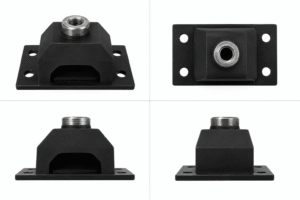
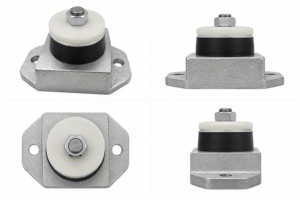
The VP series uses a compact construction combining a metal support base, an elastic rubber element, mounting fasteners, and a threaded connection. Depending on the model, an insulating pad is incorporated into the assembly.
Its principal structural features include:
- Heavy-Duty Metal Base: Provides a stable mounting interface and transfers static loads to the supporting framework.
- Resilient Rubber Element: Helps absorb mechanical movement and reduce vibration transmission through the support.
- Thermal Insulating Pad: Helps limit conductive heat transfer from exhaust pipe connections to the rubber component.
- Threaded Connection: Provides a practical interface for securing the supported assembly.
- Reinforced Mounting Structure: Supports mechanical stability under appropriately designed loading conditions.
The rubber compound can be selected according to the operating environment, including requirements for resistance to oil, weathering, and temperature exposure. The actual compound and its suitability must be confirmed for each application.
Thermal insulation is especially important in exhaust piping systems. Although the exhaust gas may reach elevated temperatures, the rubber element must remain within its specified temperature limits. Insulating pads, suitable mounting geometry, and adequate separation from hot surfaces help manage this requirement.
VP Rubber Elastic Support Models and Load Ratings
The VP series provides several configurations for different installation dimensions and load requirements.
| Model | Maximum Load | Thread Connection |
|---|---|---|
| VP-025 | 500 kg | M12 |
| VP-026 | 1,000 kg | M16 |
| VP-027 | 1,500 kg | M16 |
| VP-030 | 2,000 kg | M20 |
| VP-210 | 2,450 kg | M20 |
The specified maximum loads are reference values for preliminary selection. The final working load must be evaluated according to the actual mounting configuration, dynamic loading, and applicable design requirements.
Which Exhaust Systems Benefit from VP Rubber Elastic Supports?
VP Rubber Elastic Supports are particularly relevant to industrial installations where exhaust piping requires both mechanical stability and vibration isolation.
Marine Diesel Engine Exhaust Systems
Marine propulsion engines and auxiliary diesel generators generate vibration that can travel through exhaust piping into the vessel’s steel structure.
In shipboard installations, VP Rubber Elastic Supports can be considered for suitable mounting positions associated with:
- Marine main propulsion engine exhaust pipes
- Auxiliary diesel generator exhaust stacks
- Shipboard emergency generator exhaust piping
- Marine boiler exhaust duct support structures
- Engine room vertical exhaust pipe assemblies
The elastic support helps reduce the direct transmission of mechanical vibration between the exhaust pipe and the supporting structure.
For marine applications, engineers must also account for vessel motion, thermal expansion, corrosion exposure, and pipe support loads. Rubber elastic supports should be integrated with suitable expansion joints, pipe guides, and other structural restraints where required.
Diesel Generator Exhaust Piping in Power Facilities
Diesel generator sets are widely used in emergency power systems, data centers, industrial facilities, and remote power generation installations.
During operation, the engine produces mechanical vibration and exhaust pressure pulsations. These forces may be transmitted through rigid exhaust piping into nearby structural components.
VP Rubber Elastic Supports can be evaluated for:
- Data center standby diesel generator exhaust systems
- Containerized diesel generator exhaust piping
- Emergency power station exhaust stacks
- Industrial generator room exhaust installations
- Diesel-driven fire pump engine exhaust piping
Properly selected elastic supports help limit structure-borne vibration while maintaining the intended support arrangement.
For generator installations, particular attention should be given to thermal movement and the forces acting on exhaust flexible connectors. Elastic supports should not be used as substitutes for correctly designed pipe anchors or guides.
Industrial Engine and Exhaust Pipe Support Applications
Industrial engines and combustion equipment often require robust exhaust support systems capable of operating under continuous vibration and elevated ambient temperatures.
Potential applications include:
- Reciprocating gas engine exhaust piping
- Industrial diesel engine exhaust systems
- Engine-driven compressor exhaust installations
- Combined heat and power engine exhaust systems
- Industrial boiler exhaust support assemblies
The combination of a rigid metal mounting base and a resilient rubber element makes the VP series a potential solution where mechanical support and vibration control must be considered together.
Selection should be based on the actual pipe load, excitation frequency, installation geometry, and thermal environment rather than load capacity alone.
Frequently Asked Questions About VP Rubber Elastic Support
1. What Is the Difference Between a VP Rubber Elastic Support and a Rigid Pipe Support?
A rigid pipe support primarily provides mechanical restraint and transfers loads directly to the supporting structure. A VP Rubber Elastic Support introduces a resilient rubber interface that can reduce the transmission of vibration under suitable operating conditions.
However, elastic supports allow some deformation, which must be considered in the piping design. They cannot automatically replace rigid anchors, guides, or structural restraints. The correct choice depends on pipe movement, vibration frequency, load direction, and the required degree of positional control.
2. How Can Engineers Determine the Required Load Capacity for a VP Rubber Support?
Engineers should first calculate the total supported weight, including the pipe, insulation, fittings, attachments, and any additional loads transferred to the support. The load distribution must then be evaluated according to the support locations and structural stiffness.
Uneven load distribution, thermal expansion forces, and dynamic vibration loads may affect individual supports. The selected model should have adequate capacity under the applicable design conditions. Maximum catalog load alone is insufficient to establish the required working load or safety margin.
3. Which Rubber Material Is Best for Marine Exhaust Pipe Supports?
The appropriate rubber compound depends on the temperature at the support, exposure to oil or fuel, environmental conditions, and required elastic properties.
Natural rubber may be considered where good resilience is important. Nitrile rubber is commonly used for oil-resistant applications, while EPDM is often selected for weathering resistance and certain elevated-temperature environments.
Material selection must also account for long-term compression behavior, aging, and vibration requirements. For marine exhaust installations, thermal insulation and actual rubber operating temperature are especially important.
4. Can VP Rubber Elastic Supports Be Installed on Vertical Diesel Generator Exhaust Pipes?
Yes. VP Rubber Elastic Supports can be considered for suitable vertical exhaust pipe support locations when the mechanical loads, temperature conditions, and mounting geometry are compatible with the selected model.
The piping arrangement must accommodate thermal expansion and avoid transferring excessive forces to the engine exhaust outlet. Engineers should also determine whether additional pipe guides, anchors, or flexible connectors are required.
Installation should follow an approved support design, with particular attention to alignment, fastener security, load distribution, and sufficient clearance around hot exhaust components.
5. How Does Rubber Stiffness Affect Exhaust Pipe Vibration Isolation?
Rubber stiffness influences the natural frequency of the supported system. In general, a lower natural frequency relative to the excitation frequency can improve vibration isolation, provided the system operates sufficiently above resonance.
However, softer supports may allow greater static deflection and movement. This can be undesirable for exhaust piping that requires controlled positioning.
Engineers should evaluate static stiffness, dynamic stiffness, supported mass, excitation frequency, and damping characteristics. Accurate vibration isolation predictions require suitable product stiffness data rather than relying only on the maximum load rating.
6. What Maintenance Is Required for VP Rubber Elastic Supports in Exhaust Systems?
Maintenance should include periodic inspection of the rubber element, metal base, mounting fasteners, and insulating components.
Engineers should check for rubber cracking, excessive compression, permanent deformation, oil contamination, corrosion, loose bolts, and signs of abnormal movement. Changes in exhaust pipe alignment may indicate uneven loading or deterioration of a support.
Inspection frequency should reflect operating hours, vibration severity, temperature exposure, and the importance of the equipment. Any support showing significant damage or loss of mechanical integrity should be evaluated before continued operation.
7. Can VP Rubber Elastic Supports Be Customized for Heavy-Duty Exhaust Piping Projects?
Customization may be possible when standard models do not satisfy the required mounting dimensions, load capacity, material compatibility, or connection arrangement.
Depending on engineering feasibility, modifications may include mounting plate geometry, bolt-hole positions, threaded connections, rubber compound selection, and thermal insulating components.
Customers should provide pipe or equipment weight, installation drawings, support quantity, operating temperature, load direction, and environmental conditions. For vibration-critical installations, excitation frequencies and measured vibration data are also valuable for assessing the suitability of the proposed design.
Reliable Rubber Elastic Support Solutions for Industrial Exhaust Systems
The VP Rubber Elastic Support provides a practical combination of load-bearing capability, resilient vibration control, and optional thermal protection for industrial exhaust piping installations.
From marine diesel engines and standby generator sets to industrial combustion equipment, proper support selection can help reduce structure-borne vibration and protect connected piping components.
For technical consultation or a quotation, please provide your equipment or pipe weight, dimensions, installation drawings, operating temperature, required quantities, and specific technical requirements.
Email: [email protected]
Our company’s new website is now live, featuring the latest product introductions. For more details, please visit https://shsjflex.com/