How Do WH Rubber Vibration Isolators Improve Machinery Stability?
Industrial machinery generates dynamic forces during operation. Without an effective vibration isolation system, these forces can travel through equipment frames, mounting structures, and foundations, contributing to noise, component fatigue, and maintenance problems.
The WH Type Rubber Vibration Isolator is a rubber-metal mounting component designed to reduce vibration transmission between mechanical equipment and its supporting foundation. It provides elastic support while helping control the dynamic response of machinery during normal operation.
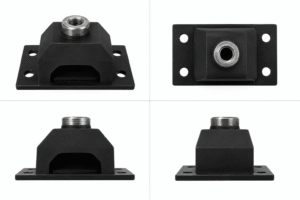
The WH series features a molded rubber body with a hollow section, a rectangular metal baseplate, and a central threaded metal insert. The four-hole mounting base provides a practical connection to steel equipment frames or concrete foundations through suitable fastening arrangements.
Rubber-Metal Construction and Vibration Control
The working principle of a WH rubber vibration isolator is based on elastic deformation and material damping.
When equipment generates periodic forces, the rubber element compresses and deforms, allowing limited relative movement between the machine and its supporting structure. This elastic movement reduces the transmission of dynamic forces when the operating frequency is sufficiently higher than the isolator’s natural frequency.
The rubber also provides inherent damping, which helps limit resonance amplification and dissipate part of the mechanical energy.
Unlike rigid steel supports, rubber vibration mounts introduce flexibility into the mounting system. However, successful isolation requires a suitable balance between vertical stiffness, lateral stability, damping, and load capacity.
Technical Advantages of the WH Series
1. Low-Frequency Vibration Isolation
The WH series has a specified natural frequency of 6 ± 1 Hz under rated loading. This characteristic makes it a potential solution for machinery operating at frequencies sufficiently above the mounting system’s natural frequency.
2. Defined Static Deflection
The rated static deflection is 12 ± 2 mm. Static deflection is an important selection parameter because it is closely related to the vertical natural frequency of an isolation system.
3. Multiple Load Ratings
The WH series includes WH-150, WH-250, WH-400, and their A/B variants, covering rated loads from 100 to 450 daN. This allows engineers to select mounting capacities according to the equipment’s supported weight.
4. Integrated Mounting Structure
The combination of a metal baseplate and threaded insert provides a convenient arrangement for connecting machinery to its supporting structure.
5. Rubber Damping Characteristics
The specified damping ratio is greater than 0.07. Damping helps control vibration response around resonance, although excessive damping can reduce isolation performance at higher frequency ratios.
WH Series Performance Specifications
| Technical Parameter | Specification |
|---|---|
| Product Type | Rubber-Metal Vibration Isolator |
| Model Series | WH-150 / WH-250 / WH-400 |
| Rated Load Range | 100–450 daN |
| Rated Static Deflection | 12 ± 2 mm |
| Natural Frequency | 6 ± 1 Hz |
| Damping Ratio | > 0.07 |
| Overall Length | 185 mm |
| Overall Height | 80 mm |
| Mounting Holes | 4 holes |
| Product Weight | 2.4–2.5 kg |
These values are based on the specified WH series data. Actual isolation performance depends on the selected model, supported load, operating frequency, and mounting configuration.
Which Industrial Equipment Benefits from WH Rubber Vibration Mounts?
WH rubber vibration isolators can be considered for a variety of machinery installations where reducing vibration transmission and maintaining stable equipment support are important.
Diesel Generator Sets and Stationary Engines
Diesel generator sets generate mechanical excitation through combustion, rotating shafts, and reciprocating engine components.
WH rubber vibration mounts may be used in suitable stationary generator installations to help reduce dynamic forces transmitted from the engine frame to the supporting structure.
Typical equipment includes industrial diesel generator sets, standby power generators, and stationary diesel-driven machinery.
For correct selection, engineers must evaluate engine operating speed, generator weight, mounting-point distribution, and startup or shutdown conditions.
Centrifugal Water Pumps and Cooling Systems
Industrial pumping systems frequently operate continuously and can transmit vibration through their foundations and connected piping.
WH rubber anti-vibration mounts may be considered for horizontal centrifugal pumps, chilled-water circulation pumps, condenser-water pumps, and industrial cooling-water pump assemblies.
Proper vibration isolation can help reduce structure-borne noise in mechanical rooms and surrounding facilities.
However, rigid pipe connections can create alternative vibration transmission paths. Flexible connectors and appropriate pipe supports may therefore be necessary to achieve the intended isolation performance.
Air Compressors and Industrial Blowers
Industrial air compressors generate vibration from rotating or reciprocating components. Depending on the compressor design, vibration may include periodic forces, torque reactions, and pulsation-related excitation.
WH rubber vibration isolators may be evaluated for selected reciprocating air compressors, rotary screw compressor packages, and motor-driven blower assemblies.
For equipment with significant dynamic forces, mount stiffness, displacement limits, and mechanical stability must be carefully reviewed.
Industrial Ventilation and Motor-Driven Equipment
Centrifugal exhaust fans, industrial ventilation blowers, and electric motor-driven machinery may also benefit from properly selected rubber isolation mounts.
In these applications, vibration often results from rotating imbalance, shaft misalignment, or mechanical excitation.
The WH series can provide a flexible connection between the equipment base and its supporting structure, helping reduce vibration transmission when the mounting system is correctly engineered.
For variable-speed equipment, engineers should assess the complete operating speed range to identify potential resonance conditions.
Frequently Asked Questions
1. What is the difference between WH rubber vibration isolators and conventional rubber mounts?
WH rubber vibration isolators are characterized by a defined mounting geometry and specified load, deflection, frequency, and damping parameters. These characteristics allow engineers to evaluate their suitability for machinery vibration isolation.
Conventional rubber mounts may use different shapes, stiffness characteristics, and installation arrangements.
The most important distinction is not simply the product appearance but its measured dynamic performance. When comparing alternatives, engineers should review rated load, natural frequency, static deflection, damping, allowable displacement, and mounting dimensions rather than selecting products based only on similar external geometry.
2. How many WH rubber vibration isolators are required for one machine?
The number of isolators depends on the equipment weight, center of gravity, frame geometry, and available mounting positions. Four mounting points are common for rectangular machinery bases, but this arrangement is not suitable for every installation.
Engineers should calculate the load supported at each position rather than assuming equal weight distribution.
For example, a machine with an offset motor or compressor may place greater loads on one side. The selected isolators should accommodate these differences while maintaining appropriate static deflection and equipment stability during operation.
3. Can WH rubber vibration isolators reduce low-frequency vibration?
WH rubber vibration isolators have a specified natural frequency of 6 ± 1 Hz under rated loading. Their ability to isolate low-frequency vibration depends on the relationship between this natural frequency and the equipment’s excitation frequency.
For effective isolation, the excitation frequency generally needs to be sufficiently higher than the isolator’s natural frequency.
Equipment operating near resonance may experience increased vibration rather than reduced vibration. Very low-speed machinery may therefore require a lower-frequency isolation system, such as appropriately designed spring isolators or pneumatic vibration isolation equipment.
4. What should engineers consider when choosing the rubber material?
Rubber material selection should account for operating temperature, chemical exposure, oil contact, environmental aging, fatigue resistance, and required dynamic stiffness.
Natural rubber is often considered for its resilience and fatigue performance. Nitrile rubber is commonly selected for applications involving certain petroleum-based oils, while EPDM offers advantages in weathering and ozone resistance.
However, rubber compounds with similar hardness may have different dynamic properties. Changing the compound can affect natural frequency, damping, and long-term deformation. Material substitutions should therefore be evaluated through appropriate mechanical and environmental testing.
5. How can improper installation affect vibration isolation performance?
Improper installation can reduce isolation efficiency and introduce unwanted mechanical stress into the rubber elements.
Uneven mounting surfaces, incorrect bolt alignment, excessive preload, and unequal load distribution can change the effective stiffness of the mounting system.
Rigid connections between isolated machinery and surrounding structures can also bypass the isolators and transmit vibration directly.
During installation, technicians should verify equipment leveling, mounting alignment, static deflection, and clearance for movement. After commissioning, vibration measurements can help determine whether the installed system performs as intended under normal operating conditions.
6. What maintenance is required for WH rubber vibration isolators?
WH rubber vibration isolators should be inspected periodically for cracking, hardening, permanent deformation, separation between rubber and metal, corrosion, and loose mounting hardware.
Inspection intervals depend on operating conditions, environmental exposure, equipment vibration levels, and maintenance requirements.
Oil contamination, excessive temperatures, and sustained overload can accelerate rubber deterioration. Changes in equipment alignment or abnormal vibration may indicate mounting problems.
If significant deterioration or permanent deformation is observed, the isolator should be evaluated for replacement. Maintaining suitable operating loads and preventing unnecessary chemical exposure can help support reliable long-term performance.
7. Can WH rubber vibration isolators be manufactured with different dimensions or load capacities?
Customized WH rubber vibration isolators may be considered when standard dimensions or rated loads do not meet project requirements.
Potential customization options include mounting-hole arrangements, threaded connection sizes, rubber compounds, metal components, and surface treatments.
However, modifications to rubber geometry or material properties may change stiffness, damping, and vibration isolation characteristics.
For engineering evaluation, customers should provide equipment drawings, total weight, center-of-gravity location, mounting-point dimensions, operating frequency, environmental conditions, and required performance. Customized designs should undergo appropriate verification before being approved for production.
Conclusion
The WH Type Rubber Vibration Isolator is a practical rubber-metal mounting solution for industrial machinery requiring controlled vibration transmission and stable mechanical support.
Its defined load capacities, low natural frequency, integrated mounting structure, and rubber damping characteristics make it suitable for evaluation in diesel generator sets, industrial pumps, compressors, ventilation equipment, and other machinery installations.
For technical consultation, product selection, customized dimensions, or quotations, please provide your equipment weight, installation dimensions, technical drawings, and operating requirements.
Email: [email protected]
Our company’s new website is now live, featuring the latest product introductions. For more details, please visit https://shsjflex.com/