How Do TD2 Spring Hangers Improve Vibration Isolation?
The TD2 Suspended Spring Vibration Isolator is designed to reduce mechanical vibration transmission and structure-borne noise in suspended equipment, HVAC installations, and industrial piping systems. It provides an effective alternative to rigid suspension supports where vibration control is essential for equipment operation and building comfort.
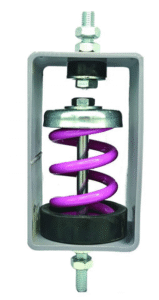
The TD2 spring hanger features a rectangular steel housing, a spring compression plate, and a large-diameter steel isolation spring. This configuration provides stable vertical support while allowing controlled elastic movement under operating loads.
One of its distinguishing features is the large-diameter spring design. The spring diameter exceeds its working compression height, improving stability during compression and helping reduce the possibility of spring tilting or lateral instability.
Another important feature is the enlarged suspension rod opening, which accommodates approximately 30 degrees of rod movement without contact with the steel frame under the intended installation conditions. This design reduces the risk of unwanted metal-to-metal contact, which could otherwise create a direct vibration transmission path.
Engineering Advantages of the TD2 Spring Hanger
Stable Spring Support
The large-diameter spring provides a stable supporting structure for suspended equipment. Correct load selection helps maintain consistent spring compression and reliable operation.
Reduced Structure-Borne Noise
By introducing an elastic spring element between equipment and structural supports, the TD2 helps limit vibration transmission through suspension rods into ceilings, beams, and building frameworks.
Controlled Vertical Deflection
Spring deflection is an important parameter in vibration isolation design. The TD2 series provides different spring configurations to accommodate various equipment loads and isolation requirements.
Flexible Suspension Arrangement
The enlarged bottom opening allows angular movement of the suspension rod, helping accommodate minor installation misalignment without creating unnecessary contact between the rod and housing.
Compact Industrial Construction
The rectangular steel housing offers a practical design for suspended mechanical installations where structural reliability, installation accessibility, and space utilization are important.
Which Industrial Equipment Can Benefit from TD2 Spring Hangers?
TD2 suspended spring vibration isolators can be integrated into mechanical suspension systems across commercial buildings, industrial facilities, and HVAC engineering projects.
Ventilation Fans and Air Handling Systems
Ventilation equipment generates mechanical vibration through rotating impellers, electric motors, bearings, and airflow-induced forces.
Typical equipment includes:
- Belt-driven centrifugal ventilation fans
- Direct-drive centrifugal exhaust fans
- Ceiling-mounted mixed-flow duct fans
- Inline axial ventilation fans
- Suspended air handling units (AHUs)
- Heat recovery ventilation units (HRVs)
- Energy recovery ventilators (ERVs)
- Commercial kitchen exhaust duct systems
When correctly selected, spring hangers help reduce the transfer of vibration from these systems to overhead building structures.
For high-speed fans, engineers should consider both rotational frequency and other excitation sources, including blade-pass frequency and motor-related vibration.
Chilled Water and Mechanical Piping Systems
Suspended pipelines can transmit vibration generated by pumps, compressors, and other connected mechanical equipment.
TD2 spring hangers may be considered for:
- Chilled water supply and return piping
- Condenser water circulation pipelines
- Cooling tower water piping
- Pump discharge and suction piping supports
- Suspended HVAC mechanical room pipelines
- Industrial cooling water distribution systems
For these applications, spring hangers should be evaluated together with flexible pipe connectors, anchors, guides, and other supporting components.
Proper coordination helps reduce the risk of vibration bypassing the isolation system through rigid connections.
Noise-Sensitive Commercial and Industrial Facilities
TD2 spring hangers are relevant to building projects where mechanical noise and vibration require careful management.
Examples include hospital mechanical rooms, hotel HVAC installations, office building ventilation systems, commercial laboratories, shopping centers, and industrial production facilities.
In these environments, the suspension design should consider equipment vibration characteristics, structural stiffness, acoustic requirements, and the potential transmission of vibration through connected services.
Frequently Asked Questions (FAQ)
1. What Is the Difference Between a TD2 Spring Hanger and a Rubber Vibration Hanger?
A TD2 spring hanger uses a steel coil spring as its primary elastic isolation element, while a rubber vibration hanger relies on the deformation of an elastomeric material.
Spring hangers are commonly selected when relatively large static deflection and low natural frequency are required. Rubber hangers may be suitable for applications with different load, frequency, and damping requirements.
The most appropriate solution depends on equipment operating speed, vibration frequency, supported weight, available installation space, and environmental conditions. Neither type should be selected solely on the basis of material.
2. How Can Engineers Determine the Required Spring Deflection?
Required spring deflection is determined by the desired isolation performance and the equipment’s dominant excitation frequencies.
For an ideal vertical spring system, the natural frequency can be estimated using the relationship between gravitational acceleration and static deflection.
Greater static deflection generally produces a lower natural frequency, which can improve vibration isolation when the excitation frequency is sufficiently above resonance.
Engineers should also consider the actual load distribution, available movement clearance, operating conditions, and spring characteristics. Manufacturer load-deflection curves should be used to verify the selected TD2 model.
3. What Is the Natural Frequency of a TD2 Spring Hanger?
The natural frequency of a TD2 spring hanger depends on its spring stiffness and the supported mass. It is therefore not a single fixed value for every model or installation.
The supplied TD2 selection chart illustrates the relationship between supported load and natural frequency for different model configurations.
During selection, engineers should identify the operating vibration frequencies and compare them with the expected natural frequency of the suspended system.
A sufficient frequency separation is important because operation near resonance may increase vibration rather than reduce it.
4. Can TD2 Spring Hangers Support Equipment with Uneven Weight Distribution?
Yes, a suspension system can be designed for equipment with uneven weight distribution, provided that each hanger is selected according to its actual supported load.
For example, an air handling unit may have heavier components concentrated near the fan or motor section. Consequently, the loads at individual suspension points may differ significantly.
Engineers should calculate support reactions using the equipment center of gravity and suspension geometry.
Different TD2 models may be required at different mounting points to achieve appropriate spring compression and maintain the equipment in a level operating position.
5. How Can Metal-to-Metal Contact Affect Spring Hanger Performance?
Metal-to-metal contact can create a rigid vibration transmission path that bypasses the elastic spring element.
For example, if a suspension rod contacts the steel housing during operation, mechanical vibration may transfer directly into the supporting structure, reducing the effectiveness of the isolation system.
The TD2 design incorporates an enlarged bottom opening to accommodate suspension rod movement and reduce this risk.
However, correct installation remains essential. Suspension rods should be properly aligned, and sufficient clearance should be maintained under normal operating and expected movement conditions.
6. Are TD2 Spring Hangers Suitable for Outdoor or Corrosive Environments?
Suitability depends on the environmental conditions and the materials and protective finishes specified for the spring hanger.
Outdoor installations may expose the steel housing and spring to moisture, temperature changes, and airborne contaminants. Coastal or industrial environments can introduce additional corrosion risks.
For these applications, customers should specify the installation location, expected temperature range, humidity, and corrosive exposure.
Protective coatings or alternative material configurations may be evaluated according to manufacturing capabilities. Any proposed surface treatment should be confirmed before ordering rather than assuming standard indoor finishes provide adequate protection.
7. What Information Is Required to Order Customized TD2 Spring Hangers?
For accurate selection or customization, customers should provide the total operating weight of the suspended equipment, number of suspension points, and equipment dimensions.
Technical drawings should identify mounting positions, available overhead clearance, suspension rod sizes, and any installation restrictions.
Additional information such as motor speed, operating vibration frequency, environmental conditions, and desired isolation performance can help engineers evaluate the application.
Where special dimensions, load capacities, or surface treatments are required, these should be clearly stated in the inquiry so manufacturing feasibility and technical suitability can be reviewed.
Improve Equipment Stability with TD2 Spring Vibration Isolators
The TD2 Suspended Spring Vibration Isolator combines a stable large-diameter spring, durable rectangular steel housing, and flexible suspension rod clearance to support effective vibration control in suspended mechanical systems.
Whether the application involves HVAC equipment, industrial ventilation fans, or mechanical piping, correct spring hanger selection can help reduce unwanted vibration transmission and improve the overall performance of the suspension system.
For technical consultation, product selection, or customized quotations, please provide your equipment weight, dimensions, installation drawings, operating conditions, and specific vibration isolation requirements.
Email: [email protected]
Our company’s new website is now live, featuring the latest product introductions. For more details, please visit https://shsjflex.com/