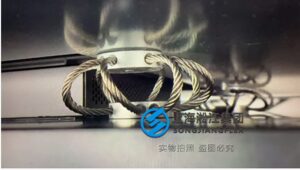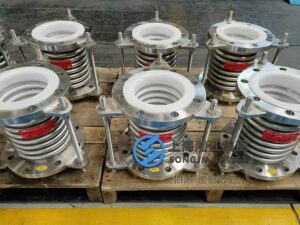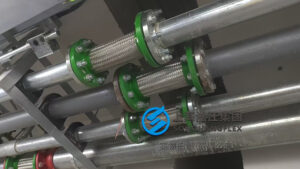
A rubber expansion joint may appear to be a simple flexible component, but its role in an industrial piping system can be critical. Pumps, cooling towers, chillers, heat exchangers, compressors, filtration skids, and process equipment all generate different combinations of vibration, thermal movement, hydraulic pulsation, and mechanical displacement.
When additional corrosion resistance and movement control are required, a 304 stainless steel restrained rubber expansion joint provides a combination of a flexible elastomer body, stainless steel flanges, and external control rods.
But when should this design be selected, and how should engineers specify it?
Understanding Pressure Thrust in Flexible Piping
One of the key engineering considerations for a flexible rubber connector is pressure thrust.
Internal pressure acts on the effective area of the flexible joint. Unlike a completely rigid pipe section, a rubber bellows can move axially. If the piping arrangement does not adequately control this force, the joint may extend beyond its intended operating range.
This is why an industrial restrained expansion joint may incorporate:
- Stainless steel threaded rods
- Control rod plates
- Nuts
- Steel or stainless steel washers
- Rubber washers
- Spherical washers
- Conical washers
- Compression sleeves where required
Together, these components form a mechanical restraint system around the flexible element.
What Makes the 304 Stainless Steel Version Different?
A conventional rubber expansion joint may use carbon-steel flanges and galvanized hardware. This is economical and suitable for many ordinary installations.
A SUS304 stainless steel flanged rubber joint, however, is attractive when the project places greater emphasis on corrosion resistance and long-term maintenance.
Typical locations include:
- High-humidity mechanical rooms
- Data center cooling plants
- Hospital HVAC plant rooms
- Commercial building chiller plants
- District cooling systems
- Food factory utility rooms
- Pharmaceutical utility systems
- Clean-water pump stations
- Industrial cooling-water systems
- Outdoor pump installations
For particularly aggressive fluids or environments, SS316L or another material may need to be evaluated instead.
Detailed Equipment Applications
Chilled-Water Plant
A central chilled-water plant may include:
- Centrifugal chillers
- Screw chillers
- Primary chilled-water pumps
- Secondary chilled-water pumps
- Condenser-water pumps
- Plate heat exchangers
- Cooling towers
- Automatic backwash filters
- Air separators
- Chemical dosing equipment
Rubber expansion joints can be installed at selected equipment connections to reduce vibration transmission and accommodate limited designed movement.
Data Center Cooling System
Modern data centers rely heavily on continuous cooling availability.
Typical equipment includes:
- Water-cooled chillers
- Air-cooled chillers
- Chilled-water pumps
- Condenser-water pumps
- Cooling towers
- Dry coolers
- CDU cooling distribution units
- Plate heat exchangers
- Emergency cooling pumps
- Diesel generator jacket-water cooling systems
In these systems, vibration and piping stress management are important because cooling equipment often operates continuously.
A stainless steel restrained flexible connector can be incorporated at suitable pump and equipment connections as part of the overall vibration-control strategy.
Fire Pump Room
Potential applications include connections around:
- Horizontal split-case fire pumps
- End-suction fire pumps
- Vertical turbine fire pumps
- Jockey pumps
- Diesel-engine-driven fire pumps
- Electric-motor-driven fire pumps
- Fire-water storage systems
The operating pressure, surge conditions, applicable fire-protection requirements, and project specifications must be reviewed before selection.
Wastewater Treatment Plant
Wastewater facilities contain many pieces of rotating and fluid-handling equipment, including:
- Sewage lift pumps
- Sludge transfer pumps
- Return activated sludge pumps
- Waste activated sludge pumps
- Backwash pumps
- Chemical dosing systems
- Filter feed pumps
- Membrane feed pumps
- Blowers
- Centrifuges
- Clarifier circulation systems
The rubber compound must be compatible with the actual wastewater composition and treatment chemicals.
Industrial Cooling-Water System
Steel mills, power plants, manufacturing facilities, semiconductor factories, battery plants, and other industrial sites use extensive cooling-water networks.
Equipment may include:
- Closed-loop cooling-water pumps
- Open-loop cooling-water pumps
- Process cooling pumps
- Cooling towers
- Plate heat exchangers
- Shell-and-tube heat exchangers
- Air compressors
- Hydraulic power units
- Vacuum pumps
- Injection molding machines
- CNC machine cooling systems
- Furnace cooling circuits
- Generator cooling circuits
Flexible rubber connections can help isolate vibration between this equipment and the main piping network.
Single Sphere or Double Sphere?
A single-sphere rubber expansion joint provides a compact installation length and is suitable for many standard pump, HVAC, and industrial water applications.
A double-sphere rubber expansion joint generally offers greater flexibility and movement capability but normally requires more installation space.
The choice should not be based simply on the assumption that more spheres are better.
Engineers should evaluate:
- Required axial movement
- Required lateral movement
- Angular deflection
- Installation length
- Operating pressure
- Equipment vibration
- Available piping space
- Pipe-support arrangement
For larger diameters or special movement requirements, a hand-built rubber expansion joint may be more appropriate than a conventional molded spherical design.
What Information Is Required Before Ordering?
A reliable quotation should start with complete operating data.
The following information is recommended:
Nominal Diameter: DN50, DN100, DN150, DN300, DN600, etc.
Working Pressure: Normal continuous operating pressure.
Design Pressure: Maximum pressure considered by the system design.
Surge/Test Pressure: Particularly important for pump discharge lines.
Temperature: Minimum, normal, and maximum operating temperatures.
Medium: Water, chilled water, cooling water, wastewater, oil, chemical solution, seawater, etc.
Flange Standard: EN 1092-1, ASME/ANSI, JIS, GB or customized dimensions.
Face-to-Face Length: Especially important for replacement projects.
Movement: Required axial compression, axial extension, lateral movement, and angular movement.
Vacuum: Confirm whether the joint will experience negative pressure.
Installation Position: Pump suction, pump discharge, heat exchanger connection, cooling tower piping, or another position.
Providing these parameters makes it possible to select the rubber material, reinforcement structure, flange material, and restraint configuration more accurately.
Why Is Vacuum Condition Important?
Pump suction piping can operate under negative pressure. A rubber expansion joint designed only for positive internal pressure may behave differently under vacuum.
Depending on joint diameter and vacuum level, additional reinforcement may be required to help the rubber body resist inward deformation.
For applications involving substantial negative pressure, specify:
- Normal vacuum
- Maximum vacuum
- Duration of vacuum condition
- Pipe diameter
- Operating temperature
- Fluid medium
A vacuum-resistant rubber expansion joint may use additional internal or external reinforcement depending on its construction.
Does a Restrained Joint Eliminate the Need for Pipe Anchors?
No.
This is one of the most important points in expansion-joint engineering.
Control rods are intended to control movement of the flexible joint within a defined range. They should not automatically be treated as replacements for the piping system’s anchors, guides, structural supports, or equipment foundations.
The piping designer should consider the complete load path, including:
- Pipe dead weight
- Fluid weight
- Pressure thrust
- Thermal expansion
- Equipment vibration
- Valve loads
- Water hammer
- Support locations
- Anchor locations
- Equipment nozzle allowable loads
The rubber expansion joint is one component within this complete system.
How Does a Rubber Expansion Joint Reduce Vibration?
Rubber is inherently more flexible and highly damped compared with a rigid steel spool.
When positioned correctly between vibrating equipment and rigid piping, the elastomeric section can reduce transmission of dynamic motion through the pipe connection.
This makes rubber expansion joints especially relevant to rotating equipment such as centrifugal pumps, circulation pumps, compressors, chillers, and cooling-tower systems.
However, a rubber joint should be considered part of a complete vibration-control solution. Equipment may also require spring isolators, rubber mounts, inertia bases, flexible electrical connections, flexible ducts, and properly designed pipe supports.
Choosing the Correct Rubber Compound
EPDM
Commonly considered for:
- Chilled water
- Cooling water
- HVAC water
- Many clean-water applications
- Selected wastewater applications
NBR
Often considered for:
- Certain oil-containing fluids
- Lubrication-related service
- Selected petroleum-based media
NR
Natural rubber offers high elasticity and useful vibration-damping properties for compatible service conditions.
CR
Neoprene/chloroprene rubber may be selected where a combination of weathering and other environmental resistance is needed.
FKM
FKM may be considered for selected chemical or elevated-temperature applications where standard elastomers are unsuitable.
The actual compound must always be verified against medium + concentration + temperature + pressure, rather than selected solely from a general material description.
Installation Mistakes to Avoid
Using the Joint to Pull Misaligned Pipes Together
A rubber expansion joint should not be forced into severe lateral or angular misalignment during installation. Doing so consumes part of its available movement before the system even starts operating.
Allowing the Joint to Carry Pipe Weight
Pipe weight should be supported by dedicated structural supports.
Incorrect Control Rod Adjustment
If control rods are set incorrectly, they may either prevent the joint from performing its intended movement or allow excessive extension.
Ignoring Pump Suction Vacuum
Large-diameter pump suction connections require particular attention to negative-pressure conditions.
Selecting Rubber Without Checking the Medium
A rubber compound suitable for water may not be appropriate for oil, strong acid, alkali, solvent, or another chemical medium.
Frequently Asked Questions
What is the difference between a normal rubber expansion joint and a restrained rubber expansion joint?
The main difference is the external restraint assembly. A conventional rubber joint relies on the surrounding piping system to control its movement and pressure-thrust effects. A restrained design incorporates control rods, plates, nuts, and washers to mechanically limit excessive extension. This can provide additional protection in systems where pressure fluctuations or piping movement need closer control.
Are SUS304 control rods better than carbon-steel control rods?
SUS304 provides better general corrosion resistance and can reduce coating-maintenance requirements. This is useful in humid mechanical rooms, outdoor installations, cooling-water plants, and clean industrial environments. However, material selection should still be based on actual environmental conditions. More aggressive chloride or chemical environments may require SS316L or another material.
Can a restrained rubber joint absorb lateral movement?
Yes, provided the joint has been designed and selected for the required lateral movement. The control rod arrangement must also permit the intended movement. Do not assume that adding control rods automatically increases movement capacity; their primary function is restraint and movement control.
Can rubber expansion joints be used for seawater?
Potentially, but seawater service requires careful review of both the rubber compound and all metallic components. Chloride exposure is particularly important for stainless steel selection. Actual temperature, pressure, seawater chemistry, installation environment, and required service life should be provided before confirming the construction.
Should a rubber joint be installed before or after a pump?
Rubber expansion joints can be used on both pump suction and discharge connections, depending on the piping design. Suction-side applications require particular attention to vacuum conditions, while discharge-side applications require attention to working pressure, surge pressure, and pressure thrust. The surrounding pipe supports and anchors must also be correctly designed.
How do I replace an old rubber expansion joint if I do not know its model?
The most useful approach is to provide the existing joint’s DN, face-to-face length, flange outside diameter, flange inside diameter, bolt circle diameter, number and diameter of bolt holes, rubber material if known, pressure, temperature, medium, and clear photographs. A dimensional drawing is even better. Replacement selection should reproduce the required piping interface while also checking whether the current operating conditions have changed since the original joint was installed.
Can customized stainless steel flanges be manufactured?
Yes. Flange dimensions and drilling can be manufactured according to EN, ASME/ANSI, JIS, GB, or project-specific drawings. For non-standard or large-diameter piping, providing the mating flange OD, ID, PCD, bolt-hole quantity, and bolt-hole diameter helps ensure dimensional compatibility before production.
Final Engineering Consideration
A 304 stainless steel restrained rubber expansion joint should not be viewed simply as a piece of rubber between two flanges. It is an engineered flexible piping component combining vibration isolation, movement accommodation, pressure-thrust restraint, and corrosion-resistant hardware.
Correct performance depends on selecting the entire assembly according to the actual piping system.
Before manufacturing, always confirm:
DN + flange standard + installation length + medium + temperature + working pressure + maximum pressure + vacuum + required movement + installation position.
With these parameters correctly defined, a restrained rubber expansion joint can provide a reliable flexible connection for pumps, chillers, cooling towers, water-treatment equipment, industrial cooling systems, and many other fluid-handling installations.
Our company’s new website is now live, featuring the latest product introductions. For more details, please visit https://shsjflex.com/
[email protected]