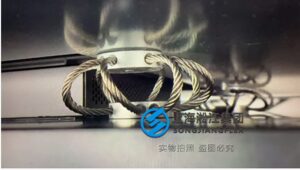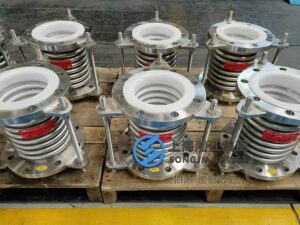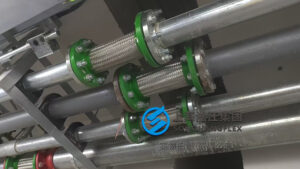
In a recent mechanical-room application, JWT Stainless Steel Flexible Metal Hoses were installed as flexible piping connections around the building’s HVAC water-pump system.
Mechanical equipment rooms are among the most common locations for flexible metal hose applications. Pumps, chillers, heat exchangers, compressors, and other rotating equipment operate for long periods and can continuously introduce vibration into connected piping.
JWT stainless steel flexible hoses are designed to provide a durable flexible section in these piping systems, helping accommodate controlled movement and reduce mechanical vibration and piping stress.
What Happens When a Pump Is Connected Directly to Rigid Piping?
A pump and its connected piping do not operate as completely independent components.
When a pump motor rotates, vibration can travel from the motor through the pump casing and into the suction and discharge piping.
This vibration transmission path can involve:
Motor → Pump → Flange → Pipe → Pipe Support → Building Structure
Over long operating periods, unwanted vibration and piping stress may contribute to noise, loose connections, fatigue around rigid joints, or additional loads on pump nozzles.
Installing an engineered flexible connection near the equipment helps interrupt this rigid transmission path.
Typical JWT Stainless Steel Flexible Hose Applications
JWT flexible metal hoses can be considered for many types of mechanical equipment, including:
- End-suction centrifugal pumps
- Horizontal split-case pumps
- Vertical inline pumps
- Vertical multistage pumps
- Chilled water circulation pumps
- Condenser water pumps
- Cooling tower pumps
- Hot water circulation pumps
- Boiler circulation pumps
- Heat exchanger circulation pumps
- Industrial process pumps
- Booster pump systems
- Water treatment equipment
- HVAC hydronic pump skids
- Cooling equipment
- Mechanical equipment-room piping
This makes flexible metal connectors particularly useful in commercial HVAC systems, industrial plants, hotels, hospitals, shopping centers, office buildings, data centers, manufacturing facilities, and central utility plants.
Application in Chilled Water Systems
Chilled water systems are a major application area.
A typical centralized HVAC chilled-water loop may contain:
Chiller → Primary Chilled Water Pump → Distribution Header → Secondary Pump → Air Handling Unit / Fan Coil → Return Header → Chiller
Depending on system design, flexible connectors can be installed around pumps and other equipment where vibration isolation or controlled movement is required.
The chilled water itself may operate at relatively moderate temperatures, but the system can run thousands of hours every year. Long-term mechanical reliability is therefore important.
Application in Data Center Cooling Systems
Data centers are another relevant application area for flexible metal hose technology.
Modern data centers may contain:
- Chilled water pumps
- Cooling tower pumps
- Centrifugal chillers
- Screw chillers
- Plate heat exchangers
- Cooling Distribution Units (CDUs)
- CRAH cooling systems
- Pump skids
- Glycol circulation systems
- Dry coolers
- Liquid cooling manifolds
Flexible metal hose assemblies can be incorporated into chilled-water and glycol piping networks where equipment vibration, thermal cycling, or limited piping movement must be managed.
For mission-critical cooling systems, material compatibility, welding quality, pressure testing, connection integrity, and correct installation become particularly important.
Corrugated Stainless Steel Hose Structure
JWT flexible metal hose consists of a flexible corrugated metal section combined with an external stainless steel braid.
The corrugated section provides flexibility.
Instead of behaving like a rigid pipe, the corrugations permit controlled deformation when the hose experiences specified movement.
The external braid provides restraint and mechanical reinforcement. This combination allows the assembly to remain flexible while operating under internal pressure.
End connections can then be welded to the hose assembly according to project requirements.
Depending on the piping system, these may include:
- Carbon steel flanges
- Stainless steel flanges
- Threaded fittings
- Welded pipe ends
- Customized end fittings
Material and connection selection should always match the actual operating conditions.
Vibration Isolation Is a System, Not a Single Product
A flexible metal hose alone cannot solve every pump vibration problem.
For effective vibration control, engineers should consider the entire installation.
A typical pump vibration-control system may include:
- Spring isolators under the pump base
- Rubber vibration isolators
- Concrete inertia bases
- Flexible metal pump connectors
- Rubber expansion joints
- Spring pipe hangers
- Vibration-isolated pipe supports
- Correct pipe anchors
- Proper pump alignment
For example, installing a pump on spring isolators while connecting it directly to completely rigid piping can create a vibration bypass path.
Likewise, installing a flexible hose while leaving the pump rigidly connected to a vibrating structural base may limit the overall isolation performance.
The best results come from treating the pump, base, piping, supports, and flexible connections as one vibration-control system.
Stainless Steel Hose vs. Rigid Pipe
Rigid steel pipe is excellent for transporting fluids but provides very little flexibility.
A stainless steel flexible hose adds a controlled flexible section to the piping system.
This can be useful for:
- Pump vibration isolation
- Mechanical equipment connections
- Limited thermal movement
- Minor installation tolerance
- Equipment maintenance connections
- Reducing piping stress
- Noise and vibration control
However, flexibility does not mean unrestricted movement. Every hose has design limitations involving pressure, temperature, bend radius, movement, and installation geometry.
Why Is Hose Length Important?
Selecting a flexible hose based only on nominal diameter is not sufficient.
The overall length directly influences its ability to accommodate movement.
A hose that is too short may be excessively stiff for the required movement and can experience high stress at the end fittings.
An unnecessarily long hose may also create installation problems.
For engineering selection, customers should provide:
- DN / NPS
- Overall hose length
- Working pressure
- Design pressure
- Operating temperature
- Fluid medium
- Connection type
- Required movement
- Installation direction
- Equipment type
With these parameters, the hose assembly can be matched more accurately to the actual application.
Why Are End Connections Important?
The flexible section is only one part of the complete assembly.
End connections determine how the hose integrates with the piping system.
For flanged piping, engineers need to confirm information such as:
- Flange standard
- Nominal diameter
- Pressure class
- Flange material
- Flange outside diameter
- Bolt-hole quantity
- Bolt-hole diameter
- Bolt circle diameter
- Sealing-face type
Common projects may specify EN, ASME/ANSI, JIS, GB, or other flange standards.
JWT flexible metal hose assemblies can therefore be customized to match different international piping systems.
Correct Installation Helps Extend Service Life
Many flexible hose problems are related not only to product design but also to installation.
The following practices are important:
Avoid torsion: A corrugated hose is designed primarily for specified flexible movement, not twisting around its longitudinal axis.
Respect minimum bend radius: Excessive bending concentrates stress in the corrugations.
Align the piping: Do not use the hose to pull severely misaligned pipe flanges together.
Support the pipe independently: Excessive pipe weight should not hang directly from the flexible hose.
Protect during welding: Welding sparks and spatter can damage thin stainless steel corrugations or braid wires.
Check operating conditions: Pressure and temperature must remain within the design range.
Inspect periodically: During maintenance, check the braid, welds, corrugated section, and end fittings for abnormal deformation or damage.
What Information Should Be Provided for a JWT Flexible Hose Inquiry?
For faster technical selection and quotation, customers are encouraged to provide:
- Nominal diameter
- Required face-to-face length
- Working pressure
- Design pressure
- Medium
- Operating temperature
- Connection standard
- Hose and flange material requirements
- Installation position
- Connected equipment type
A piping drawing, pump datasheet, or installation photograph can make selection even more accurate.
FAQ
Where are JWT Stainless Steel Flexible Hoses commonly installed?
Typical applications include HVAC mechanical rooms, chilled-water pump rooms, cooling-water systems, boiler rooms, industrial utility rooms, data-center cooling plants, pump skids, and process equipment piping. They are particularly useful near rotating equipment such as centrifugal pumps, chillers, compressors, and circulation pumps where vibration or limited movement needs to be isolated from rigid piping.
What is the difference between a metal hose and a metal expansion joint?
Although both products use metallic flexible elements, they are not identical. A braided flexible metal hose is generally a relatively long, flexible corrugated hose assembly reinforced with external braid and fitted with end connections. A metal expansion joint usually contains one or more engineered bellows sections specifically designed to accommodate defined axial, lateral, or angular movement. The correct product depends on movement magnitude, pressure, temperature, piping layout, vibration characteristics, and installation space.
Can stainless steel flexible hoses absorb thermal expansion?
They can accommodate limited movement when specifically designed and installed for that movement. However, they should not automatically be treated as substitutes for engineered expansion joints or expansion loops. Large thermal movements require proper calculation of pipe expansion, anchor loads, guide positions, movement direction, and fatigue life.
Is SS304 or SS316L better for flexible metal hoses?
There is no universal answer. SS304 can be suitable for many general HVAC and industrial water applications, while SS316L provides improved corrosion resistance in certain environments. The correct material depends on the transported medium, chloride content, chemicals, temperature, external environment, and required service life. For aggressive fluids, seawater, chemicals, or high-chloride environments, material compatibility should be reviewed carefully rather than selecting a grade based only on price.
Can a stainless steel flexible hose eliminate pump vibration completely?
No flexible connector should be expected to eliminate all vibration by itself. It helps reduce the transmission of vibration into connected piping, but overall performance also depends on pump balance, alignment, equipment base design, vibration isolators, pipe supports, anchors, operating speed, and piping geometry. If the pump itself has abnormal vibration caused by cavitation, bearing damage, shaft misalignment, or impeller imbalance, the root cause should be corrected rather than relying on the flexible hose to mask the problem.
What details are needed when ordering a customized JWT flexible metal hose?
At minimum, provide nominal diameter, length, operating pressure, temperature, fluid medium, connection type, and quantity. For engineered applications, also provide design pressure, flange standard, required movement, installation orientation, equipment type, pipe layout, and environmental conditions. If the hose connects directly to a pump, chiller, compressor, or heat exchanger, equipment nozzle drawings are especially useful for confirming dimensional compatibility.
Contact Us
Our company’s new website is now live, featuring the latest product introductions. For more details, please visit https://shsjflex.com/
[email protected]