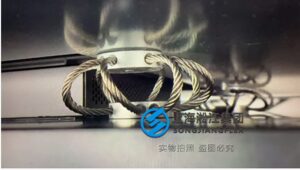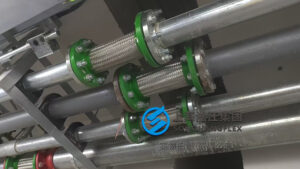
Copper processing plants often operate complex chemical piping systems carrying copper sulfate solutions, acidic electrolytes, process chemicals, and wastewater containing dissolved metals. These pipelines connect pumps, tanks, electrolytic cells, heat exchangers, filtration units, and crystallization equipment, making them an important part of the entire production process.
Unlike ordinary water pipelines, special chemical piping must deal with more than pressure. Engineers also need to consider chemical corrosion, temperature changes, thermal expansion, equipment movement, pipeline misalignment, and long-term operating reliability.
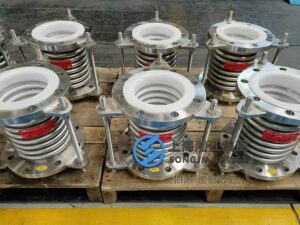
For these applications, a PTFE-Lined Stainless Steel Bellows Expansion Joint can provide both corrosion protection and flexible movement compensation.
Where Is Copper Sulfate Piping Used?
Copper sulfate piping can be found in several industrial processes, particularly in copper refining, hydrometallurgy, electroplating, electrowinning, electrorefining, copper sulfate production, and chemical wastewater treatment.
In an electrorefining or electrowinning plant, for example, electrolyte solution may circulate continuously between different pieces of process equipment.
Typical equipment connected by these pipelines includes:
- electrolyte circulation tanks
- copper electrorefining cells
- electrowinning cells
- electrolyte storage tanks
- acid-resistant circulation pumps
- chemical transfer pumps
- magnetic-drive pumps
- solution preparation tanks
- plate heat exchangers
- cartridge and bag filtration systems
- filter presses
- evaporators
- cooling crystallizers
- copper sulfate crystallization tanks
- chemical dosing systems
- wastewater collection tanks
- neutralization tanks
- metal recovery systems
Each connection point introduces different piping requirements. Pumps can introduce vibration, heated process liquids can cause thermal expansion, and chemical composition determines the corrosion resistance required from wetted components.
Therefore, selecting an expansion joint for such a system requires an understanding of the complete process pipeline, not just the nominal pipe diameter.
Why Is Corrosion a Concern in Copper Processing Pipelines?
The term “copper sulfate pipeline” does not always describe the complete chemical environment.
For example, electrolyte used in copper processing may contain copper sulfate and sulfuric acid, together with process additives and other dissolved substances. Temperature and chemical concentration may also change at different stages of the process.
This means that simply specifying “stainless steel” does not automatically confirm that every wetted component is suitable for the application.
A PTFE lining provides an additional chemical-resistant barrier between the process medium and the metallic bellows. Instead of exposing the thin stainless steel convolutions directly to the process fluid, the PTFE-lined design helps isolate the metal flexible element from the corrosive medium.
This is one of the reasons PTFE-lined expansion joints, fluoropolymer-lined piping components, and corrosion-resistant bellows are widely considered for aggressive chemical service.
Why Combine PTFE with a Stainless Steel Bellows?
PTFE and stainless steel perform different functions within the expansion joint.
The PTFE inner lining is primarily responsible for separating the corrosive process medium from the metallic flexible structure.
The stainless steel bellows provides flexibility and allows the expansion joint to accommodate specified pipeline movement.
This combination makes the product particularly useful when a project simultaneously requires:
chemical resistance + thermal expansion compensation + compact installation + pressure-containing capability.
In a properly engineered system, the expansion joint may be designed for axial movement, lateral movement, angular movement, or a defined combination of movements, depending on the pipeline layout.
However, allowable movement must always be confirmed according to the actual bellows design rather than assumed from pipe diameter alone.
Application Around Electrolyte Circulation Pumps
Electrolyte circulation pumps are critical equipment in many copper processing systems.
Typical installations may use horizontal centrifugal chemical pumps, fluoroplastic-lined centrifugal pumps, magnetic-drive pumps, acid circulation pumps, or other corrosion-resistant process pumps.
The pump continuously transfers electrolyte between storage tanks, treatment equipment, heat exchangers, filters, and electrolytic cells.
Pipeline forces generated by thermal expansion or installation deviation should not be unnecessarily transferred to pump nozzles. A correctly selected PTFE-lined stainless steel bellows expansion joint can accommodate designed piping displacement and help manage mechanical loads within the piping system.
However, the expansion joint should not be used as a substitute for proper pipe supports, anchors, guides, or pump alignment. These components must work together as part of the overall piping design.
Application in Copper Sulfate Crystallization Lines
Copper sulfate production and recovery systems may involve several processing stages, such as:
solution preparation → filtration → evaporation → concentration → cooling → crystallization → solid-liquid separation → drying.
Equipment used in these stages may include evaporators, heat exchangers, circulation pumps, cooling crystallizers, crystallization vessels, centrifuges, filtration equipment, mother-liquor tanks, and product recovery systems.
Because the solution temperature may vary significantly between processing stages, connecting pipelines can repeatedly expand and contract.
A metal bellows expansion joint provides a compact way of accommodating calculated thermal displacement, while the PTFE liner provides protection for the wetted side when corrosive chemical media are present.
Application in Electroplating and PCB Production
Copper sulfate-based electrolytes are also associated with copper electroplating and printed circuit board manufacturing.
A typical process line may contain:
- copper plating tanks
- electrolyte recirculation pumps
- filtration units
- chemical dosing pumps
- solution heaters
- heat exchangers
- storage tanks
- transfer pipelines
- rinse-water systems
- wastewater treatment equipment
These production lines often have limited installation space. In some locations, creating a large pipe expansion loop may be difficult.
A compact PTFE-lined metal expansion joint can therefore be considered where movement compensation is required, provided that the pipe anchors, guides, pressure thrust, movement direction, and installation conditions have been properly evaluated.
What About Sulfuric Acid in the Electrolyte?
This is an important question.
When copper sulfate is combined with sulfuric acid, material selection should be based on the actual complete electrolyte composition, rather than evaluating copper sulfate and sulfuric acid independently.
Important parameters include:
- CuSO₄ concentration
- H₂SO₄ concentration
- chloride content
- other process additives
- operating temperature
- maximum design temperature
- normal working pressure
- design pressure
- possible vacuum condition
- expected service life
PTFE has broad chemical resistance and is widely used in corrosive chemical handling systems. However, the chemical resistance of the liner alone does not determine the operating limits of the complete expansion joint.
The PTFE liner, stainless steel bellows, flanges, welds, tie rods or external hardware, temperature, pressure, and movement requirements must all be considered together.
Why Are Anchors and Pipe Guides Important?
Installing a bellows expansion joint does not mean that the pipeline can move freely in every direction.
When internal pressure acts on the effective area of a bellows, pressure thrust can be generated. The piping system therefore needs a properly engineered arrangement of main anchors, intermediate anchors, pipe guides, supports, and expansion joints.
Guides help control the direction of pipe movement, while anchors help manage loads and pressure thrust according to the system design.
For this reason, we recommend reviewing the installation drawing before manufacturing a custom expansion joint, especially for long chemical pipelines, large diameters, high movement requirements, or pump-connected systems.
What Should Be Provided for a Custom Expansion Joint?
For special chemical piping, please provide as much information as possible before quotation and production:
Pipeline medium: Copper sulfate, sulfuric acid, mixed electrolyte, or other chemicals
Chemical concentration: Percentage of each major component
Temperature: Normal and maximum operating temperature
Pressure: Working pressure and design pressure
Nominal diameter: DN or NPS
Face-to-face length: Required installation length
Axial movement: Compression and extension requirements
Lateral movement: Required transverse displacement
Angular movement: If applicable
Flange standard: EN, ASME, JIS, GB, GOST, or project-specific dimensions
Bellows material: According to project requirements
Connection type: Flanged or welded
Vacuum condition: If applicable
Pipeline drawing: Preferably showing anchors, guides, equipment, and installation position
The more complete the process information, the more accurately the expansion joint can be designed for the actual application.
FAQ
1. Is PTFE lining necessary for every copper sulfate pipeline?
Not necessarily. Material selection depends on the actual chemical composition, concentration, temperature, pressure, impurities, and expected service conditions.
A relatively mild copper sulfate solution may have different material requirements from a hot acidic electrolyte containing copper sulfate, sulfuric acid, chlorides, and other process chemicals.
PTFE lining becomes particularly valuable when the project requires a highly corrosion-resistant wetted barrier while still needing the flexibility of a metallic bellows. For this reason, we recommend evaluating the complete process medium rather than selecting the expansion joint based only on the name “copper sulfate.”
2. Can the PTFE-lined bellows compensate for both axial and lateral movement?
Yes, a bellows expansion joint can be engineered for different movement requirements, including axial, lateral, and angular displacement.
However, the allowable movement depends on the specific bellows geometry, number of convolutions, installation length, pressure, temperature, and structural configuration.
For example, increasing the lateral movement requirement may require a different bellows design or overall length. Therefore, customers should provide the actual calculated movement rather than simply requesting the maximum possible movement.
If axial and lateral movements occur simultaneously, this should also be clearly stated during the design stage.
3. Can the expansion joint be installed directly next to a chemical pump?
It can be installed in pump-connected piping when the system design requires movement compensation, but the installation location should be evaluated carefully.
The expansion joint should not be expected to correct serious pump misalignment or compensate for an incorrectly supported pipeline. Pump nozzles, piping supports, anchors, guides, and the expansion joint must be considered as one mechanical system.
For critical electrolyte circulation pumps, we recommend providing the pump arrangement and piping drawing so that the expected movement and installation conditions can be reviewed before final selection.
4. How long can a PTFE-lined stainless steel expansion joint last?
There is no single service-life figure that applies to every chemical pipeline.
Service life depends on factors including chemical concentration, operating temperature, pressure, movement amplitude, movement cycles, installation quality, bellows stress, pipeline alignment, and external mechanical loads.
Correct installation is particularly important. Excessive movement, torsion, incorrect anchor positions, or using the expansion joint to compensate for severe piping misalignment can significantly reduce bellows life.
For applications involving frequent thermal cycling, the expected number of operating cycles should be provided during the design stage so that fatigue requirements can be considered.
Special Chemical Piping Requires Application-Specific Design
A PTFE-Lined Stainless Steel Bellows Expansion Joint is especially useful where a pipeline must handle both corrosive chemical media and mechanical movement.
In copper sulfate production, electrorefining, electrowinning, electroplating, PCB manufacturing, hydrometallurgy, and chemical wastewater treatment, the expansion joint may become a critical flexible component connecting pumps, tanks, heat exchangers, filters, evaporators, crystallizers, and process pipelines.
The correct solution starts with the process conditions.
Send us your chemical composition, concentration, temperature, pressure, DN size, installation length, movement requirements, flange standard, and pipeline drawing, and we can evaluate a suitable configuration for your application.
Our company’s new website is now live, featuring the latest product introductions. For more details, please visit Shanghai Songjiang Vibration Absorber Co., Ltd.
Email: [email protected]