What Makes the V-Type Damped Spring Hanger Vibration Isolator Effective?
The V-Type Damped Spring Hanger Vibration Isolator is an industrial suspension isolation device designed to reduce mechanical vibration transmission and structure-borne noise in suspended equipment installations.
Unlike rigid metal hangers, which can transmit mechanical vibrations directly into supporting structures, this isolator uses a combination of elastic spring support and rubber damping components to create a flexible connection between equipment and building structures.
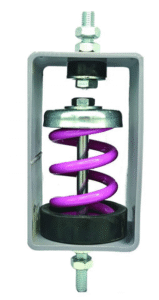
The product typically consists of a damping spring, rubber composite isolation pads, a V-shaped metal supporting frame, and suspension connection components.
Each component contributes to the overall vibration control system.
Spring-Rubber Composite Isolation Structure
1. Damping Spring Assembly
The steel spring provides elastic support for suspended equipment. Its stiffness and operating deflection influence the natural frequency of the isolation system.
When properly selected, the spring can reduce vibration transmission from rotating machinery operating above the system’s resonance frequency.
2. Rubber Composite Isolation Pads
Rubber isolation pads introduce additional damping and help prevent direct metal-to-metal contact between structural components.
These elements can reduce the transmission of certain vibration frequencies and improve the overall behavior of the suspension system.
3. V-Shaped Metal Supporting Frame
The V-shaped metal frame provides structural support for the spring and rubber isolation components.
Its compact configuration allows integration into various suspended mounting arrangements, including ceiling-mounted HVAC equipment and industrial piping systems.
4. Suspension Connection Components
Threaded rods and compatible connection hardware allow the isolator to be installed between suspended equipment and supporting beams or ceiling structures.
Correct alignment and load distribution are essential to achieving reliable performance.
Technical Advantages of V-Type Spring Hangers
The main benefits of this composite vibration isolation design include:
-
Reduced transmission of mechanical vibration into building structures
-
Spring-supported isolation for suspended equipment
-
Additional damping from rubber composite components
-
Compact construction for restricted installation spaces
-
Compatibility with different suspension arrangements
-
Adaptable load capacity and mounting configurations
-
Potential reduction of structure-borne equipment noise
The effectiveness of a vibration isolator depends on proper engineering selection rather than spring construction alone.
Factors such as supported mass, excitation frequency, spring stiffness, damping, and mounting conditions must be considered during product selection.
Which Industrial Equipment Benefits from V-Type Spring Hangers?
V-Type Damped Spring Hanger Vibration Isolators are used in mechanical installations where equipment vibration may be transmitted through suspension rods, ceiling supports, and structural steelwork.
HVAC Ventilation and Air Handling Systems
Typical equipment includes:
-
Backward-curved centrifugal exhaust fans
-
Forward-curved centrifugal ventilation fans
-
Inline axial flow fans
-
Mixed-flow duct ventilation fans
-
Ceiling-suspended air handling units
-
Fan coil units with centrifugal blowers
-
Energy recovery ventilation units
-
Heat recovery ventilation equipment
In these systems, rotating fans and motors generate periodic excitation forces that may travel through rigid equipment supports.
Properly selected spring hangers help interrupt these vibration transmission paths.
Industrial Piping and Mechanical Systems
Spring vibration isolation hangers can also be considered for suspended piping connected to vibrating mechanical equipment.
Examples include chilled water distribution pipes, condenser water return lines, HVAC circulation pump piping, compressor-connected utility piping, and industrial ventilation ducts.
For piping systems, engineers must evaluate both vibration control and mechanical support requirements.
Thermal expansion, pipe weight, operating pressure, fluid weight, and movement restrictions should be considered before finalizing the hanger arrangement.
Laboratory and Precision Equipment
Selected spring hanger configurations may be suitable for lightweight suspended laboratory equipment, measuring assemblies, and mechanical testing devices.
However, highly sensitive instruments may require specialized isolation systems with lower natural frequencies or additional vibration control measures.
Frequently Asked Questions (FAQ)
1. How Does a V-Type Damped Spring Hanger Work?
A V-type damped spring hanger works by introducing an elastic suspension between vibrating equipment and the supporting structure.
The spring supports the equipment weight and allows controlled movement, while the rubber components provide damping and reduce direct vibration transmission through the mounting assembly.
The isolator’s effectiveness depends on the relationship between the equipment’s excitation frequency and the isolation system’s natural frequency.
When the operating frequency is sufficiently higher than the natural frequency, vibration transmission can be significantly reduced.
2. What Is the Difference Between a Spring Hanger and a Rubber Hanger?
Spring hangers primarily use steel springs to provide elastic support and vibration isolation, while rubber hangers rely on the deformation and damping properties of elastomeric materials.
Steel spring systems can be designed for relatively large static deflections, making them useful for certain low-frequency vibration applications.
Rubber hangers generally provide greater inherent material damping but often have different stiffness and deflection characteristics.
A spring-rubber composite hanger combines both mechanisms, although its final performance depends on the specific design and operating conditions.
3. How Is the Required Spring Stiffness Determined?
Spring stiffness is determined by evaluating the supported load, desired static deflection, and target natural frequency.
For a simplified linear vertical spring system, stiffness is related to load and deflection through the equation k = F/δ, where F is the supported force and δ is the static deflection.
The corresponding natural frequency can be estimated using the supported mass and effective spring stiffness.
Actual selection should also consider rubber stiffness, load distribution, dynamic behavior, and manufacturer-specific spring characteristics.
4. What Load Capacity Should Be Selected for Suspended Equipment?
The selected load capacity should match the actual operating load supported by each suspension point.
Equipment weight, attached components, operating fluids, and any additional supported accessories must be considered.
For installations with multiple suspension points, individual hanger loads may differ because of uneven weight distribution or equipment geometry.
An isolator that is significantly underloaded may not achieve its intended static deflection, while excessive loading can cause overcompression or mechanical damage.
Engineering calculations and manufacturer load tables should guide the final selection.
5. Can V-Type Spring Hangers Reduce Low-Frequency Vibration?
V-type spring hangers may reduce low-frequency vibration when the isolation system is designed with a sufficiently low natural frequency.
Effective isolation requires an appropriate frequency relationship between the equipment excitation and the suspension system.
If the operating frequency is close to resonance, vibration amplification may occur instead of reduction.
For low-speed machinery, larger static deflections or specialized isolation arrangements may be necessary.
Engineers should review equipment rotational speed, vibration frequency data, and required isolation performance before selecting the spring configuration.
6. What Installation Problems Can Reduce Isolation Performance?
Several installation issues can reduce the effectiveness of spring vibration hangers.
Common problems include uneven hanger loading, incorrect spring compression, misaligned suspension rods, and rigid contact between isolated equipment and surrounding structures.
Rigid piping connections, electrical conduits, or improperly supported ductwork can also create unintended vibration transmission paths.
Installation teams should verify equipment alignment, hanger loading, connection integrity, and clearance around isolated components.
Final inspection should confirm that the system can move as intended without interference.
7. Can V-Type Damped Spring Hangers Be Manufactured for Special Applications?
Yes. V-type damped spring hangers can be developed for project-specific requirements, subject to engineering evaluation and manufacturing feasibility.
Customization may involve spring stiffness, rated load range, frame dimensions, rubber materials, connection sizes, and surface protection.
Applications involving high humidity, corrosive environments, unusual installation geometry, or special vibration requirements may require additional design considerations.
Customers should provide equipment drawings, operating weight, installation dimensions, vibration frequencies, environmental conditions, and required performance criteria to support accurate technical evaluation.
Find the Right V-Type Damped Spring Hanger for Your Equipment
The V-Type Damped Spring Hanger Vibration Isolator combines elastic spring support with rubber damping components to provide a practical vibration control solution for suspended industrial equipment.
Correct load selection, installation alignment, and vibration frequency evaluation are essential for reliable isolation performance.
For technical consultation or customized product selection, please provide your equipment weight, dimensions, installation drawings, and operating requirements.
Email: [email protected]
Our company’s new website is now live, featuring the latest product introductions. For more details, please visit https://shsjflex.com/