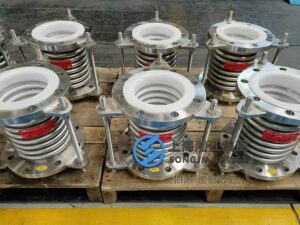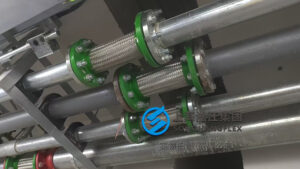
In a diesel fuel system, a rubber expansion joint performs more than simple displacement compensation. Installed between rigid pipelines and vibration-generating equipment, it can help isolate mechanical vibration, accommodate controlled pipeline movement, reduce structure-borne noise, and protect connected equipment from unnecessary piping stress.
However, a rubber expansion joint used for water service and one designed for diesel service should not automatically be considered interchangeable.
The key difference is fluid compatibility.
For this reason, diesel-resistant expansion joints are commonly manufactured with a specially formulated NBR inner rubber layer. NBR is widely recognized for compatibility with petroleum oils, mineral oils, diesel fuel, and fuel oils.
What Makes a Rubber Joint Diesel Resistant?
A typical fuel-resistant rubber expansion joint is a reinforced flexible structure rather than a simple piece of molded rubber.
Depending on the design, it may incorporate an NBR inner rubber layer, reinforcing textile cord, external protective rubber, embedded reinforcing elements, and carbon-steel or stainless-steel flanges.
Commercial fuel-service expansion joints provide a useful reference for this construction concept. Trelleborg’s fuel-compatible ERV Yellow, for example, uses a seamless NBR inner wall, textile reinforcement, CR outer wall, and metal flanges. Its higher-pressure Yellowsteel version incorporates steel-wire reinforcement and is intended for fuels, lubricants, hydraulic oils, and other demanding petrochemical applications.
This layered construction allows each component to perform a different function: the inner rubber provides medium resistance, reinforcement carries pressure-related loads, the outer rubber protects the structure, and the flange system connects the joint to the pipeline.
Pressure Testing with Diesel as the Test Medium
For a diesel-resistant rubber expansion joint, pressure testing can be performed according to the agreed project inspection procedure.
Where the customer’s specification requires diesel-medium testing, the joint can be filled with the specified diesel test medium and gradually pressurized under controlled conditions.
The inspection process should focus on the complete assembly rather than only the rubber surface.
Engineers typically observe whether there is any visible leakage, abnormal bulging, local deformation, flange-area leakage, structural instability, or unusual dimensional change during the specified pressure-holding period.
After depressurization, the rubber body and connection areas should also be inspected for abnormal permanent deformation or visible damage.
This type of test can be particularly valuable for customized fuel-service expansion joints where the purchaser wants verification under conditions representative of the intended medium.
Diesel Generator Fuel Transfer Systems
Modern mission-critical facilities depend heavily on standby diesel generators.
A large data center, for example, may have several high-power generator sets together with bulk diesel storage tanks, fuel transfer pumps, day tanks, duplex fuel filters, fuel polishing units, automatic fuel control valves, supply manifolds, and return piping.
During operation, transfer pumps and generator engines introduce mechanical vibration into the fuel system.
A correctly selected diesel generator rubber expansion joint can therefore be installed at strategic points to provide a flexible transition between rotating equipment and fixed pipework.
Potential installation locations include the discharge side of a diesel transfer pump, pump suction piping where the design permits, fuel circulation skids, filtration units, fuel conditioning equipment, and other auxiliary fuel systems.
Applications in Pump and Mechanical Equipment
Diesel-resistant flexible joints can also be considered for numerous industrial machines and systems, including:
Centrifugal Diesel Transfer Pumps used between bulk storage tanks and day tanks.
Gear Pumps used for fuel-oil transfer and metering systems.
Twin-Screw and Screw Pumps commonly encountered in fuel and lubricating-oil transfer applications.
Diesel Generator Sets used in data centers, hospitals, airports, factories, telecom facilities, and commercial buildings.
Marine Diesel Engines and Auxiliary Generator Sets where fuel and lubricating-oil piping require specialized flexible connections subject to applicable marine requirements.
Industrial Burner Systems using diesel or light fuel oil for boilers, furnaces, thermal-oil heaters, and process heating equipment.
Fuel Filtration and Polishing Skids containing circulation pumps, separators, filters, valves, instrumentation, and rigid interconnected piping.
Fuel Storage and Transfer Stations connecting tanks, pump skids, distribution manifolds, and associated piping.
These applications make fuel pump vibration isolation, flexible pipe connection, and oil-resistant elastomer compatibility important engineering considerations.
NBR vs. EPDM for Diesel Piping
Choosing between NBR and EPDM is one of the most common questions in rubber expansion joint selection.
EPDM offers excellent weather, ozone, and water-service characteristics, making it a popular material for HVAC, cooling water, water treatment, and many general industrial piping applications.
Diesel service is different.
NBR is specifically associated with petroleum oils, diesel fuel, and fuel oils. Parker notes that NBR provides good resistance to aliphatic hydrocarbons, petroleum oils, mineral oils, diesel, and fuel oils.
Therefore, when the actual medium is diesel, NBR is normally the more appropriate basic material choice than EPDM, subject to verification against the exact operating conditions.
What About Higher Temperature Fuel Systems?
Temperature must be considered together with chemical compatibility.
A material being described as “oil resistant” does not mean that it can operate indefinitely at any oil temperature.
Different NBR formulations have different temperature limits. Parker’s general guidance shows that NBR compounds can provide useful oil and fuel resistance but also highlights the importance of compound-specific temperature capability. For more severe environments, HNBR provides improved high-temperature and ozone resistance, while FKM offers particularly strong high-temperature oil and fuel resistance.
This means the correct engineering question is not simply:
“Is NBR resistant to diesel?”
It should be:
“Is this specific NBR compound compatible with this diesel formulation at the specified temperature and pressure for the required service life?”
That distinction is important for long-term reliability.
Flexible Connections for Data Center Emergency Power Systems
Data centers provide an increasingly important application for diesel-resistant flexible connectors.
Emergency power infrastructure may include large generator sets, underground or above-ground bulk fuel tanks, intermediate day tanks, redundant transfer pumps, fuel polishing systems, automatic valves, monitoring instruments, and interconnected fuel supply and return lines.
Because reliability is critical, flexible connectors should not be selected only by matching the nominal pipe diameter.
Engineers should evaluate diesel compatibility, pressure rating, vibration isolation, flange dimensions, installation length, allowable movement, temperature, reinforcement construction, pipeline restraint, and maintenance accessibility.
Where project requirements demand it, customized testing documentation and material certificates can also form part of the inspection package.
Installation Considerations for Fuel-Service Rubber Joints
Correct installation is just as important as correct material selection.
The joint should not be used to compensate for excessive piping misalignment beyond its rated movement capability. Pipeline anchors and guides must be properly designed, and excessive torsion should be avoided during flange installation.
For larger sizes or systems subject to significant pressure thrust, control rods or restraint units may be required to limit excessive extension and protect the rubber-to-flange structure.
The surrounding installation environment also matters. Marine engine rooms and other fire-sensitive environments may have additional requirements for fire protection and emergency isolation. DNV documentation for certain approved rubber expansion joints specifies isolation provisions for piping conveying fuel oil and lubricating oil and places restrictions on particular installation locations.
FAQ
1. What rubber material is recommended for diesel fuel expansion joints?
NBR, or nitrile rubber, is one of the most widely used elastomers for diesel, fuel oil, petroleum oils, and mineral oils because of its favorable oil resistance and mechanical properties.
However, “NBR” is a material family rather than one universal compound. The actual formulation should be selected according to diesel composition, aromatic content, temperature, pressure, environmental exposure, and required service life.
2. Can the finished expansion joint actually be pressure tested with diesel?
Yes, where diesel-medium testing is part of the agreed inspection procedure and the manufacturer has suitable test facilities and safety controls.
The test should follow a defined procedure specifying the test medium, test pressure, holding time, temperature, inspection criteria, and safety requirements. Pressure should be raised in a controlled manner while the rubber body, flanges, sealing surfaces, and reinforcement structure are monitored.
The exact test pressure should be based on the approved product specification rather than applying a universal value to every rubber expansion joint.
3. What should be checked after a diesel pressure test?
The inspection should look beyond obvious leakage.
Important observations include the rubber body’s appearance, flange sealing areas, reinforcement stability, abnormal swelling, local bulging, permanent deformation, cracking, separation, or other visible changes.
For a documented project test, the inspection record may also include product identification, test medium, pressure, duration, test date, and acceptance result.
4. Can these expansion joints be used with lubricating oil as well as diesel?
Potentially yes, because appropriately formulated NBR has broad compatibility with many petroleum-based oils and lubricants. Fuel-compatible industrial expansion joints are also commercially specified for lubricants and hydraulic oils.
Nevertheless, the exact lubricant should be confirmed. Additive packages, operating temperature, and chemical composition can affect elastomer compatibility, so the manufacturer’s material confirmation should be obtained for unusual or high-temperature oils.
5. What details are needed to customize a diesel-resistant expansion joint?
Provide the nominal diameter, flange standard and dimensions, face-to-face length, working pressure, required test pressure, operating temperature, exact diesel or fuel specification, axial/lateral/angular movement, vacuum requirement, installation orientation, and quantity.
It is also helpful to identify the connected equipment—for example, diesel generator, fuel transfer pump, screw pump, gear pump, day tank, fuel polishing skid, burner fuel pump, or marine auxiliary engine. Knowing the equipment allows the flexible joint to be evaluated as part of the actual piping system rather than as an isolated component.
6. Does a diesel-resistant rubber joint also reduce vibration?
Yes. The elastomeric body provides flexibility and can help reduce transmission of vibration from pumps, engines, and other rotating machinery into connected rigid piping.
However, vibration isolation performance depends on the joint’s construction, dimensions, rubber properties, operating pressure, and installation. Proper pipe supports, anchors, guides, and equipment alignment remain necessary. A flexible joint should complement good piping engineering rather than replace it.
Contact Us
Our company’s new website is now live, featuring the latest product introductions. For more details, please visit https://shsjflex.com/ [email protected]