Noise problems in modern buildings are not always caused by insufficient wall thickness. In many cases, unwanted sound travels through rigid structural connections between drywall, ceilings, metal framing, concrete slabs, and other building components.
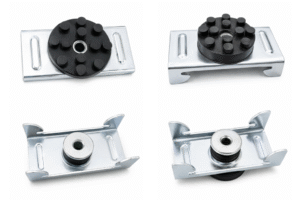
RAIC Type Sound Isolation Clips are designed to reduce these direct vibration transmission paths. By combining a strong metal bracket with an elastic rubber isolation element, RAIC clips create a resilient connection between the main building structure and the secondary wall or ceiling system.
This mechanical decoupling helps control structure-borne noise, airborne sound, impact noise, and mechanical vibration, making RAIC clips suitable for residential, commercial, entertainment, hospitality, and industrial acoustic projects.
How Does an RAIC Sound Isolation Clip Work?
When gypsum board or metal framing is directly fixed to a concrete wall, ceiling, wood stud, or steel stud, vibration can easily travel through these rigid connections.
RAIC Type Sound Isolation Clips introduce an elastic vibration isolation layer between the structural surface and the secondary framing system.
A typical acoustic assembly may consist of:
Concrete / Wood / Steel Structure → RAIC Isolation Clip → Furring Channel → Gypsum Board → Finished Wall or Ceiling
The elastic rubber component allows a controlled degree of flexibility while reducing direct metal-to-structure vibration transmission.
This concept is commonly known as acoustic decoupling or structural vibration isolation.
RAIC Type Sound Isolation Clip Specifications
RAIC Type Sound Isolation Clips are manufactured using a combination of metal and elastic rubber components.
Typical specifications include:
- Product Name: RAIC Type Sound Isolation Clip
- Product Category: Resilient Acoustic Isolation Clip
- Dimensions: 76 × 38 × 30 mm
- Construction: Metal bracket + rubber vibration isolator
- Available Colors: Green, red and black
- Maximum Acoustic Design Load: 36 lbs / approximately 16.3 kg
- Installation: Wall and ceiling acoustic systems
- Compatible Structures: Concrete, wood studs and metal studs
- Main Function: Vibration isolation, acoustic decoupling and structure-borne noise reduction
Actual installation quantity and spacing should be determined according to the total supported weight and acoustic system design.
Where Are RAIC Acoustic Isolation Clips Commonly Used?
RAIC sound isolation clips can be used in many environments where improved sound insulation or vibration control is required.
Recording Studios and Professional Audio Rooms
Recording environments require particularly careful control of airborne and structure-borne noise.
RAIC clips can be incorporated into wall and ceiling systems for:
- Recording studios
- Podcast studios
- Broadcasting rooms
- Vocal booths
- Music rehearsal rooms
- Mixing studios
- Mastering rooms
- Radio studios
- TV production studios
- Voice-over rooms
- Drum practice rooms
- Instrument practice rooms
Equipment such as studio monitors, subwoofers, guitar amplifiers, bass amplifiers, drum kits, loudspeakers and audio systems can generate significant acoustic energy.
Decoupling the interior wall and ceiling surfaces from the primary structure helps reduce direct vibration transmission.
Home Theater and Cinema Soundproofing
Low-frequency sound generated by cinema audio systems can be difficult to control because it can excite walls, ceilings, and floors.
Typical noise-generating equipment includes:
- Subwoofers
- Surround speakers
- Cinema loudspeakers
- Bass speakers
- Audio amplifiers
- Projection equipment
- Ventilation fans
- HVAC equipment
RAIC Type Sound Isolation Clips can be used to create isolated wall and ceiling assemblies in commercial cinemas, private theaters, screening rooms, home cinemas, multimedia rooms and entertainment facilities.
When combined with high-mass gypsum board, cavity insulation and proper acoustic sealing, resilient clips can become an important part of a complete cinema soundproofing system.
Apartment and Residential Soundproofing
Noise transmission between neighboring apartments is a common acoustic problem in multi-family buildings.
Potential sources include:
- Human speech
- Television
- Music
- Children playing
- Footsteps
- Furniture movement
- Home exercise equipment
- Washing machines
- Dryers
- Air-conditioning equipment
- Water pumps
RAIC clips can be installed as part of isolated walls or suspended ceiling assemblies to reduce rigid structural connections.
Applications include bedroom walls, apartment partition walls, home offices, home theaters, music rooms, ceilings and shared walls between residential units.
Hotel Acoustic Isolation Systems
Acoustic privacy is particularly important in hotels.
Guests may be affected by noise from adjacent rooms, corridors, elevators, restaurants, conference areas, HVAC equipment, mechanical rooms and entertainment facilities.
RAIC Type Sound Isolation Clips can be incorporated into hotel wall and ceiling construction to help improve acoustic separation.
Typical applications include:
- Hotel guest rooms
- Hotel suites
- Conference rooms
- Meeting rooms
- Hotel corridors
- Restaurants
- Banquet halls
- Fitness rooms
- Entertainment areas
- Rooms adjacent to elevator shafts
- Rooms near mechanical equipment areas
A complete hotel acoustic system should also address doors, windows, ductwork, piping penetrations, electrical outlets and other potential flanking paths.
Mechanical Equipment Room Noise Control
Mechanical equipment can produce both airborne noise and structural vibration.
Typical equipment includes:
Air Handling Units (AHUs), Fan Coil Units (FCUs), centrifugal fans, axial fans, exhaust fans, ventilation fans, chillers, cooling towers, centrifugal pumps, circulation pumps, compressors, generators, electric motors, transformers and elevator machinery.
When mechanical vibration enters concrete slabs, steel framing, walls or ceilings, it may travel considerable distances through the building structure.
RAIC clips can be used as part of the surrounding acoustic wall or ceiling system to reduce structural coupling.
However, heavy mechanical equipment should normally be isolated separately using appropriate spring vibration isolators, rubber mounts, inertia bases, flexible pipe connectors or flexible duct connectors.
RAIC Clips for Suspended Ceiling Sound Isolation
Suspended ceilings can become important transmission paths for both airborne and impact noise.
A conventional ceiling that is rigidly connected to the floor structure above may transfer vibration directly into the finished ceiling.
RAIC Type Sound Isolation Clips provide a resilient connection between the main structure and the secondary ceiling framing.
They can therefore be useful for controlling:
Footstep noise, impact noise, furniture movement, gym equipment vibration, music, loudspeakers, plumbing noise and mechanical equipment vibration.
Depending on the acoustic requirements, the isolated ceiling system can be combined with mineral wool, fiberglass insulation, multiple gypsum board layers, damping materials and acoustic sealants.
RAIC Clips for Wall Acoustic Decoupling
Walls often contain many direct mechanical connections that can act as sound bridges or acoustic bridges.
By introducing resilient isolation clips between the structural wall and secondary framing, engineers can reduce some of these rigid transmission paths.
This type of wall construction can be particularly useful for:
- Shared apartment walls
- Hotel room partitions
- Recording studio walls
- Cinema walls
- Conference rooms
- Office meeting rooms
- Music classrooms
- School auditoriums
- Healthcare consultation rooms
- Broadcasting facilities
The effectiveness of the finished wall depends on the complete assembly, including wall mass, cavity depth, insulation, sealing and control of flanking transmission.
What Is Structure-Borne Noise?
Structure-borne noise occurs when mechanical energy enters a solid building element and travels through it as vibration.
For example, a pump may generate vibration that enters a concrete floor. The vibration can then travel through the slab and re-radiate as audible noise in another room.
Similar problems can be generated by:
HVAC fans, compressors, elevators, generators, water pumps, piping systems, footsteps, loudspeakers and industrial machinery.
RAIC Type Sound Isolation Clips help reduce structure-borne transmission by introducing a resilient interface into wall and ceiling construction.
Airborne Noise vs. Structure-Borne Noise
Understanding the difference between these two types of noise is important when designing an acoustic system.
Airborne noise travels primarily through the air. Examples include conversations, television, music, traffic and loudspeakers.
Structure-borne noise begins as vibration transmitted through solid materials such as concrete, steel, timber, walls, floors and ceilings.
In real buildings, both types often occur simultaneously.
A well-designed RAIC acoustic system can contribute to controlling both problems by improving mechanical separation between structural and finishing components.
Why Is Rubber Important in an Acoustic Isolation Clip?
The elastic rubber component is the key vibration-isolating element of the RAIC clip.
Unlike a completely rigid metal connection, rubber can deform elastically under load and provide damping between connected structures.
Important rubber characteristics include:
- Hardness
- Elasticity
- Compression deflection
- Damping characteristics
- Load capacity
- Long-term deformation resistance
- Fatigue resistance
Correct loading is important because an isolation element that is overloaded or insufficiently loaded may not provide the intended vibration isolation characteristics.
For this reason, the clip quantity and layout should be selected according to the actual wall or ceiling construction.
How Should RAIC Sound Isolation Clips Be Installed?
Before installation, determine the total weight of the suspended or supported acoustic system.
This may include:
gypsum board, drywall panels, metal furring channels, acoustic panels and other supported finishing materials.
RAIC clips should then be distributed across the wall or ceiling so that the load is appropriately shared.
During installation, contractors should avoid creating unintended rigid connections between the isolated surface and the primary building structure.
For example, an incorrectly positioned screw that passes through the isolated framing and directly contacts the structural substrate may create an acoustic short circuit, reducing the performance of the entire system.
Perimeter joints, penetrations, electrical boxes, piping openings and ventilation openings should also be properly treated according to the acoustic design.
What Materials Can Be Combined with RAIC Clips?
RAIC Type Sound Isolation Clips can form part of a complete architectural soundproofing system incorporating materials such as:
- Gypsum board
- Drywall
- Furring channels
- Hat channels
- Mineral wool insulation
- Fiberglass acoustic insulation
- Acoustic panels
- Soundproofing membranes
- Damping compounds
- Acoustic sealants
- Resilient framing systems
The correct combination depends on the building structure, noise source, available installation space and required acoustic performance.
Frequently Asked Questions About RAIC Type Sound Isolation Clips
1. What are RAIC Type Sound Isolation Clips used for?
RAIC Type Sound Isolation Clips are designed primarily for architectural wall and ceiling sound isolation systems.
They create a resilient connection between the main structure and the secondary wall or ceiling framing, helping reduce direct vibration transmission.
Typical applications include recording studios, cinemas, apartments, hotels, conference rooms, offices, home theaters and mechanical equipment rooms.
The clips are especially useful when the acoustic design requires mechanical decoupling rather than simply adding more sound-absorbing material.
2. Can RAIC clips reduce footstep noise from upstairs?
RAIC clips can form part of a ceiling isolation system designed to reduce the transmission of impact and structure-borne noise from the floor above.
Footsteps create mechanical energy that enters the floor slab or timber structure. This vibration can then travel through the structure and radiate from the ceiling below.
Installing a resiliently suspended ceiling helps reduce direct mechanical coupling between the structural floor and finished ceiling.
However, severe impact noise may require additional treatment of the floor above, such as resilient underlay, floating floors or other impact-isolation materials. The best solution depends on the building construction and required acoustic performance.
3. Can RAIC clips be installed with drywall?
Yes. Drywall and gypsum board systems are among the most common applications for acoustic isolation clips.
The RAIC clips are typically connected to the structural substrate, followed by compatible metal channels. Drywall is then attached to the secondary framing rather than directly to the primary building structure.
This creates a mechanically decoupled assembly.
Multiple layers of gypsum board may also be used when greater wall or ceiling mass is required.
4. Can RAIC clips be used on both walls and ceilings?
Yes.
RAIC Type Sound Isolation Clips can be incorporated into both wall soundproofing systems and suspended ceiling isolation systems, provided the installation layout and load conditions are appropriate.
Wall applications commonly include studios, hotels, apartments, offices and cinemas.
Ceiling applications commonly address footsteps, impact sound, plumbing noise, mechanical equipment vibration and noise from upper floors.
The number and spacing of clips should be determined separately for each application.
5. How much weight can one RAIC clip support?
The maximum acoustic design load of the RAIC Type Sound Isolation Clip is approximately 36 lbs, or 16.3 kg per clip.
However, this figure should not be used as the only basis for determining the quantity of clips.
The actual design should consider total supported weight, clip spacing, channel arrangement, load distribution, structural conditions and an appropriate safety factor.
For large ceiling installations or unusual structural configurations, the complete support system should be reviewed before installation.
6. Can RAIC clips isolate vibration from chillers, pumps and AHUs?
RAIC clips can help reduce vibration transmission through the surrounding architectural wall and ceiling structure, but they are not intended to serve as the primary vibration supports for heavy mechanical equipment.
Chillers, pumps, AHUs, compressors and generators normally require dedicated vibration isolators selected according to equipment weight, operating speed, disturbing frequency and required static deflection.
These may include spring isolators, rubber mounts, inertia bases and flexible connectors.
RAIC clips can then be used in the surrounding mechanical-room walls or ceilings as part of a comprehensive noise-control strategy.
7. Is acoustic insulation still necessary when using RAIC clips?
In many projects, yes.
RAIC clips primarily provide mechanical decoupling, while mineral wool, fiberglass and other acoustic insulation materials serve different functions within the wall or ceiling cavity.
Adding cavity insulation can help control acoustic energy inside the assembly, while gypsum board provides mass and RAIC clips help reduce rigid structural transmission.
The best acoustic performance is generally achieved by treating the wall or ceiling as a complete system rather than relying on one individual component.
8. What project information is needed before selecting RAIC clips?
For an accurate recommendation, it is useful to provide:
- Wall or ceiling dimensions
- Total supported weight
- Number and thickness of gypsum board layers
- Metal channel type and dimensions
- Wood, steel or concrete substrate
- Proposed clip spacing
- Main noise source
- Required acoustic performance
- Installation drawings, if available
If mechanical equipment is responsible for the noise, additional information such as equipment name, equipment weight, operating RPM, vibration frequency and installation position is also useful.
This allows the acoustic system and any additional vibration isolation products to be selected more appropriately.
A Practical Solution for Architectural Sound and Vibration Control
Modern acoustic engineering requires control not only of airborne sound but also of vibration traveling through structural connections.
RAIC Type Sound Isolation Clips provide a compact and practical solution for creating resilient wall and ceiling assemblies.
Their metal-and-rubber construction helps introduce mechanical separation between the main building structure and the finished acoustic surface, making them suitable for recording studios, cinemas, apartments, hotels, home theaters, offices, conference rooms, broadcasting facilities and mechanical equipment rooms.
When combined with appropriate framing, gypsum board, acoustic insulation, sealing materials and professional installation, RAIC clips can become an important component of a comprehensive architectural noise and vibration control system.
Contact Us
Our company’s new website is now live, featuring the latest product introductions. For more details, please visit: