Pipelines handling abrasive slurry, mineral particles, fly ash, limestone, cement, and chemical suspensions face continuous wear during operation. When conventional flexible connectors are installed close to slurry pumps or other vibrating equipment, their inner rubber surfaces may be exposed to both high-velocity flow and aggressive particle erosion.
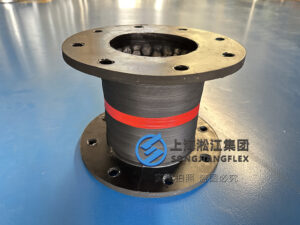
A Ceramic Lined Rubber Expansion Joint provides a specialized solution by combining the excellent abrasion resistance of industrial ceramics with the flexibility and vibration isolation performance of reinforced rubber.
This composite design is particularly suitable for mining, mineral processing, FGD systems, thermal power plants, cement plants, steel mills, and chemical processing facilities where abrasion, erosion, vibration, and pipeline movement occur simultaneously.
What Makes a Ceramic Lined Rubber Expansion Joint Different?
A conventional rubber expansion joint uses an elastomer inner layer to contact the process medium directly. This design works well for water, wastewater, air, and many general industrial fluids.
However, when the medium contains hard solid particles, continuous particle impact and sliding abrasion can gradually damage the rubber surface.
A Ceramic Lined Rubber Expansion Joint introduces a specially engineered wear-resistant ceramic lining into the internal flow area.
The basic protection principle is:
Abrasive Slurry → Ceramic Wear Layer → Reinforced Rubber Body
The ceramic layer takes the primary abrasive attack, while the rubber body continues to provide flexibility and vibration isolation.
This allows the expansion joint to perform two important functions:
Protect against abrasive wear while accommodating mechanical movement.
Excellent Abrasion and Wear Resistance
The primary advantage of a Ceramic Lined Rubber Expansion Joint is its outstanding resistance to abrasion.
High-alumina ceramic is widely used in industrial wear-protection applications because of its extremely high hardness. This makes it particularly effective against continuous sliding and erosion caused by hard mineral particles.
Typical abrasive media include:
- Mineral slurry
- Mine tailings
- Iron ore slurry
- Silica sand
- Quartz-containing slurry
- Fly ash
- Bottom ash
- Coal slurry
- Cement slurry
- Limestone slurry
- Gypsum slurry
- Chemical suspensions containing solids
Instead of allowing these abrasive particles to continuously attack the rubber inner surface, the ceramic lining acts as the primary wear barrier.
This helps protect the flexible rubber body and can significantly extend maintenance and replacement intervals in severe operating conditions.
Designed for Slurry Pump Connections
Slurry pumps are among the most important applications for Ceramic Lined Rubber Expansion Joints.
A slurry pump can generate:
- Mechanical vibration
- Hydraulic pulsation
- Turbulent flow
- High fluid velocity
- Particle impact
- Pipeline movement
- Noise transmission
Installing a flexible expansion joint close to the pump can help reduce vibration transmission into the connected piping system.
However, conventional rubber expansion joints may experience accelerated internal wear when exposed to high-velocity abrasive slurry.
A ceramic lined design addresses both problems.
The rubber body absorbs vibration and accommodates movement, while the ceramic lining protects the internal flow surface against abrasive particles.
Typical equipment includes:
- Heavy-duty slurry pumps
- Mill discharge pumps
- Tailings pumps
- Hydrocyclone feed pumps
- Thickener underflow pumps
- Mineral concentrate pumps
- Ash slurry pumps
- Coal slurry pumps
- Limestone slurry pumps
- Gypsum slurry pumps
- FGD circulation pumps
- Process slurry transfer pumps
Mining and Mineral Processing Applications
Mining and mineral processing are among the most demanding industries for piping components.
The transported media may contain highly abrasive particles such as quartz, silica, iron ore, copper ore, gold ore, phosphate rock, coal, and other mineral solids.
Ceramic Lined Rubber Expansion Joints can be considered for:
- Ore slurry pipelines
- Tailings transportation systems
- Mineral concentrate pipelines
- Grinding circuit pipelines
- Ball mill discharge systems
- SAG mill discharge systems
- Hydrocyclone feed systems
- Flotation circuits
- Thickener underflow systems
- Mine backfill systems
- Sand and gravel processing systems
- Mineral washing plants
In these applications, reducing wear is important not only for component life but also for minimizing unexpected shutdowns.
FGD Desulfurization Systems
Wet Flue Gas Desulfurization (FGD) systems represent another important application.
FGD plants circulate large quantities of limestone and gypsum slurry. These fluids contain suspended solid particles that can cause continuous erosion of piping components.
Potential installation locations include:
- Absorber circulation pump connections
- FGD recycle pump connections
- Limestone slurry pump discharge
- Gypsum slurry pump discharge
- Slurry transfer pipelines
- Hydrocyclone feed systems
- Limestone preparation systems
- Gypsum dewatering systems
- Absorber slurry circulation lines
For suitable operating conditions, an EPDM rubber body combined with a wear-resistant ceramic lining can provide a practical balance between chemical compatibility, abrasion resistance, and flexibility.
The exact rubber and ceramic materials should always be selected according to the slurry composition, chloride content, pH, temperature, pressure, and particle characteristics.
Fly Ash and Bottom Ash Handling
Thermal power plants handle large quantities of abrasive ash.
Fly ash and bottom ash particles can create severe wear in piping systems, especially when transported at high velocity or mixed with water.
Ceramic Lined Rubber Expansion Joints can be evaluated for:
- Fly ash slurry pipelines
- Bottom ash pipelines
- Ash handling pump connections
- Ash slurry pumps
- Ash water circulation systems
- Wet ash transportation systems
- Coal slurry systems
- Scrubber slurry systems
- Power plant wastewater containing solids
Ceramic wear protection is particularly useful where conventional elastomer surfaces experience premature erosion.
Cement Plant Applications
Cement manufacturing also involves highly abrasive powders and slurries.
Potential applications include:
- Cement slurry pipelines
- Limestone slurry pipelines
- Raw material slurry systems
- Mill discharge systems
- Slurry pump connections
- Dust collection systems
- Cement powder handling
- Raw material processing systems
- Wet process cement lines
- Abrasive wastewater pipelines
By combining ceramic wear protection with a flexible rubber body, the expansion joint can help protect piping systems while reducing vibration transmitted from pumps and rotating equipment.
Steel and Metallurgical Industry Applications
Steel plants and metallurgical facilities also operate many abrasive material-handling systems.
Typical applications may include:
- Iron ore slurry pipelines
- Sinter plant systems
- Blast furnace dust handling
- Steel mill dust collection
- Scrubber circulation systems
- Slag slurry pipelines
- Metallurgical wastewater
- Mineral powder transportation
- Process pump connections
These environments often combine abrasion, corrosion, vibration, and continuous industrial operation, making material selection especially important.
More Than Wear Resistance: Vibration Isolation
Wear resistance is the main reason for adding ceramic lining, but flexibility remains an equally important feature of the rubber expansion joint itself.
A properly designed Ceramic Lined Rubber Expansion Joint can help:
- Absorb pump vibration
- Reduce structure-borne noise
- Compensate for axial movement
- Accommodate lateral movement
- Allow limited angular movement
- Reduce mechanical stress on connected piping
- Compensate for minor installation misalignment
This is an important difference between a ceramic lined flexible joint and a completely rigid ceramic lined pipe.
The goal is not simply to create a wear-resistant component. It is to provide wear protection while preserving the required flexibility of the piping connection.
Can Ceramic Lined Expansion Joints Handle Corrosive Slurry?
In many cases, yes, but material selection must be based on the actual chemical composition.
Industrial ceramics generally provide good chemical stability, while the rubber body can be selected according to the transported medium.
Common combinations may include:
NR + Ceramic
Recommended for highly abrasive mineral slurry, tailings, sand, and similar particle-rich media.
EPDM + Ceramic
Suitable for many water-based slurries, FGD applications, limestone slurry, gypsum slurry, and selected acidic or alkaline solutions.
NBR + Ceramic
Can be considered for abrasive media containing oils or hydrocarbons.
CR + Ceramic
Can be considered where weather resistance, mechanical durability, and moderate chemical resistance are required.
For aggressive acids, strong alkalis, high temperatures, solvents, or complex chemical mixtures, detailed chemical compatibility analysis is required.
Ceramic lining should not be described as universally resistant to all chemicals.
Which Ceramic Material Should Be Selected?
The ceramic material should be selected according to the actual wear mechanism and operating conditions.
Alumina Ceramic
High-alumina ceramic is a common choice for industrial abrasion protection.
Its main advantages include:
- Very high hardness
- Excellent wear resistance
- Good chemical stability
- Reliable industrial performance
- Wide availability
It is particularly suitable for mining slurry, fly ash, cement, limestone, and general abrasive particle applications.
Zirconia Ceramic
Zirconia-based ceramic materials can be considered where higher toughness and impact resistance are required.
They may be useful in applications where the ceramic surface experiences both abrasion and significant mechanical impact.
Silicon Carbide Ceramic
Silicon carbide can be evaluated for particularly severe applications involving abrasion, chemical corrosion, and elevated temperatures.
The final ceramic selection should therefore consider the complete operating environment rather than wear resistance alone.
Does Ceramic Lining Affect Expansion Joint Flexibility?
This is an important engineering question.
Ceramic is hard and relatively rigid, while a rubber expansion joint must remain flexible.
Therefore, the ceramic lining cannot simply be treated like the continuous rigid lining of a straight steel pipe.
The ceramic arrangement must be specially designed according to:
- Expansion joint geometry
- Required axial movement
- Required lateral movement
- Required angular movement
- Ceramic segment dimensions
- Ceramic spacing
- Bonding method
- Flexible deformation zones
- Operating pressure
- Temperature
A properly engineered ceramic arrangement allows the rubber joint to maintain the movement capability required by the piping system while protecting critical internal surfaces from abrasion.
Can It Be Used Under Vacuum?
Yes, but vacuum conditions must be specified during product selection.
This is especially important when the expansion joint is installed on a pump suction line.
Negative pressure can cause an inadequately reinforced rubber expansion joint to deform inward or collapse.
Depending on the required vacuum resistance, the design may include:
- Vacuum reinforcing rings
- Additional internal reinforcement
- Stronger carcass construction
- Special structural support
Customers should therefore provide both the maximum positive pressure and maximum vacuum or negative pressure when requesting a quotation.
How Does Ceramic Lining Reduce Lifecycle Costs?
The purchase price of a Ceramic Lined Rubber Expansion Joint is normally higher than that of a standard rubber expansion joint.
However, initial price is only one part of the total cost.
Frequent replacement of a worn expansion joint can involve:
- Replacement product cost
- Maintenance labor
- Pipeline shutdown
- Production loss
- Lifting equipment
- Installation work
- Emergency repair
- Spare parts inventory
If a ceramic lined design significantly extends the replacement interval, the overall lifecycle cost can become more economical.
For mining plants, power stations, cement factories, and other continuous-process facilities, reducing unplanned downtime can be considerably more valuable than simply purchasing the lowest-cost flexible connector.
What Information Is Required for Custom Design?
Ceramic Lined Rubber Expansion Joints are typically selected according to actual operating conditions.
For an accurate quotation and technical proposal, please provide:
- Nominal diameter (DN / NPS)
- Face-to-face length
- Operating pressure
- Design pressure
- Operating temperature
- Design temperature
- Complete medium composition
- Solid concentration
- Particle material
- Maximum particle size
- Slurry density
- Flow velocity
- Axial movement
- Lateral movement
- Angular movement
- Vacuum or negative pressure
- Flange standard and material
- Installation location
- Pump suction or discharge application
- Required service life
For highly abrasive applications, particle size, particle hardness, solids concentration, and flow velocity are especially important for evaluating the ceramic lining design.
Frequently Asked Questions
1. What is the main purpose of a Ceramic Lined Rubber Expansion Joint?
Its primary purpose is to provide a flexible pipeline connection with improved resistance to abrasive and erosive wear.
The ceramic lining protects the internal rubber surface against slurry and solid particles, while the reinforced rubber body continues to absorb vibration and accommodate pipeline movement.
This makes it particularly useful when conventional rubber expansion joints experience premature internal wear.
2. Is it suitable for slurry pump discharge pipelines?
Yes. Slurry pump discharge is one of the most relevant applications.
These locations often experience high flow velocity, vibration, turbulence, hydraulic pulsation, and continuous particle erosion. A ceramic lined flexible joint can help isolate pump vibration while reducing direct abrasion of the rubber flow surface.
However, slurry velocity, particle size, solids concentration, operating pressure, and movement requirements should be provided before final design.
3. Can it be used for FGD limestone slurry?
Yes, depending on the complete operating conditions.
FGD limestone and gypsum slurry systems are highly relevant because they combine suspended solids, abrasion, chemical exposure, and continuous pump operation.
EPDM combined with a suitable ceramic lining may be considered for certain FGD applications. However, pH, chloride concentration, temperature, pressure, solids concentration, and other chemical components should be checked before confirming the final material.
4. Is ceramic lining better than thick rubber for abrasive slurry?
The answer depends on the operating conditions.
Thick abrasion-resistant rubber can perform very well in many slurry applications because rubber can absorb particle impact effectively. However, very hard and continuously sliding particles can gradually remove the rubber surface.
Ceramic provides much higher surface hardness and can offer excellent resistance to sliding abrasion.
For severe applications, combining the wear resistance of ceramic with the elasticity of rubber can provide an effective composite solution.
5. Will the ceramic crack when the expansion joint moves?
A poorly designed rigid ceramic arrangement could be damaged by excessive movement.
For this reason, ceramic lined rubber expansion joints require a specially engineered lining arrangement. Ceramic segment dimensions, spacing, bonding, flexible zones, and movement requirements must all be considered.
Customers should always specify required axial, lateral, and angular movements so the lining and rubber structure can be designed together.
6. Can ceramic lined rubber expansion joints resist acid and alkali?
They can be suitable for many corrosive slurry applications, but chemical resistance depends on the complete material system.
The ceramic, elastomer, bonding materials, and other wetted components must all be compatible with the medium.
For chemical applications, please provide the exact chemical name, concentration, temperature, pressure, pH, and solid content. Strong acids, strong alkalis, solvents, and high-temperature chemicals require individual evaluation.
7. What is the best rubber material for mining slurry?
Natural Rubber (NR) is often considered for severe abrasive mineral slurry because of its excellent elasticity and abrasion characteristics.
However, if chemical resistance, oil resistance, temperature resistance, or weather resistance is also important, EPDM, NBR, CR, or another specialized elastomer may be more appropriate.
The best material depends on the complete operating conditions rather than abrasion alone.
8. Can the product be customized?
Yes. Ceramic Lined Rubber Expansion Joints can be engineered according to specific pipeline requirements.
Customization may include:
- Diameter
- Face-to-face length
- Rubber compound
- Ceramic material
- Ceramic lining arrangement
- Flange standard
- Flange material
- Pressure rating
- Movement capability
- Reinforcement structure
- Vacuum reinforcement
- Control rods
- Special external rubber cover
Providing a drawing or complete technical datasheet is the fastest way to evaluate a customized design.
A Flexible Wear-Resistant Solution for Severe Slurry Service
A Ceramic Lined Rubber Expansion Joint provides an effective combination of:
Ceramic wear resistance + Rubber flexibility + Vibration isolation + Pipeline movement compensation.
It is particularly suitable for slurry pumps, mining pipelines, tailings systems, FGD circulation systems, fly ash handling, cement plants, steel mills, and chemical slurry pipelines where conventional flexible connections are exposed to severe abrasion.
For demanding applications, the correct solution should be engineered according to the actual medium, particle characteristics, pressure, temperature, flow velocity, vacuum conditions, and required movement.
Contact Us
Shanghai Songjiang Vibration Absorber Co., Ltd. specializes in the manufacture and customization of rubber expansion joints and flexible piping solutions for demanding industrial applications.
Our company’s new website is now live, featuring the latest product introductions. For more details, please visit:
Send us your pipeline drawing, operating pressure, temperature, medium composition, particle size, solids concentration, flow velocity, and movement requirements. Our team can evaluate the appropriate rubber material, ceramic lining, reinforcement structure, flange configuration, and expansion joint design for your application.