High-precision industrial equipment does not operate independently from its environment. Vibrations generated by nearby machines, production lines, building structures, HVAC equipment, pumps, compressors, forklifts, cranes, and external traffic can travel through the floor and reach vibration-sensitive equipment.
For precision measurement, semiconductor manufacturing, optical experiments, laser processing, and ultra-precision machining, controlling these vibrations can be critical.
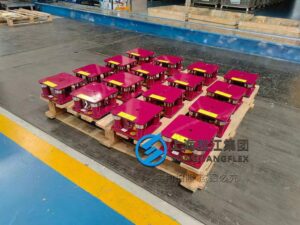
The KQJZ-B Damped Air Vibration Isolator is an industrial vibration isolation solution combining an air cushion with hydraulic damping.
The pneumatic section provides soft support and low-frequency vibration isolation, while the hydraulic damping section helps control excessive movement and dissipate vibration energy.
This integrated design makes the KQJZ-B an excellent option for machines requiring both high isolation efficiency and stable dynamic performance.
What Makes the KQJZ-B Different?
Many conventional anti-vibration mounts use rubber, elastomer, coil springs, or other elastic elements.
The KQJZ-B takes a different approach.
Its primary elastic element is a pneumatic air cushion. Because compressed air can provide relatively soft spring characteristics, pneumatic isolation is particularly attractive for applications requiring low-frequency vibration control.
At the same time, an integrated hydraulic damping system controls oscillation.
Therefore, the KQJZ-B does not simply attempt to “make the machine softer.” It is designed to achieve a controlled balance between:
Low Stiffness + Vibration Isolation + Damping + Load Support + Stability
This balance is particularly valuable for sensitive industrial and laboratory equipment.
Where Does Precision Equipment Vibration Come From?
One of the most important aspects of vibration isolation engineering is identifying the vibration source.
A machine can experience two major categories of vibration.
Internal Vibration
Internal vibration is generated by the equipment itself.
Typical sources include:
- Rotating motors
- Spindles
- Cooling fans
- Pumps
- Linear motors
- Reciprocating mechanisms
- Moving gantries
- Robotic axes
- Tool-changing systems
- High-speed rotating components
- Unbalanced rotating masses
External Vibration
External vibration enters the machine through the floor or building structure.
Typical sources include:
- CNC production lines
- Stamping presses
- Forging equipment
- Injection molding machines
- Air compressors
- Industrial pumps
- Chillers
- Cooling towers
- AHUs
- Large centrifugal fans
- Elevators
- Escalators
- Forklifts
- Overhead cranes
- Trucks
- Railway lines
- Nearby construction
For precision instruments, external floor vibration is often difficult to eliminate at the source.
Installing an appropriate pneumatic vibration isolation system underneath the sensitive equipment can therefore provide an effective secondary vibration-control strategy.
Typical Equipment Applications
Semiconductor Manufacturing and Inspection
Semiconductor manufacturing involves extremely small dimensions, making vibration control important in many production and inspection processes.
KQJZ-B air vibration isolators can be evaluated for:
- Wafer inspection machines
- Wafer probing stations
- Wafer metrology equipment
- Semiconductor microscopes
- IC inspection systems
- Semiconductor packaging machines
- Wafer bonding equipment
- Precision wafer positioning systems
- Laser wafer marking machines
- Optical inspection equipment
- Microelectronic assembly systems
- Precision semiconductor testing platforms
Optical and Laser Systems
Optical systems are particularly sensitive to relative movement between optical components.
Potential applications include:
- Optical tables
- Laser optical benches
- Laser interferometers
- Raman spectroscopy systems
- Precision microscope platforms
- Optical alignment systems
- Laser measurement equipment
- Photonics research platforms
- Precision lens inspection machines
- Laser scanning systems
- Holographic experiment platforms
- High-resolution imaging systems
Precision Measurement Equipment
Measurement systems require repeatability and a stable reference environment.
Typical equipment includes:
- CMM machines
- Vision Measuring Machines (VMM)
- 3D optical measurement systems
- Roundness testers
- Cylindricity measuring machines
- Surface roughness measuring equipment
- Contour measuring instruments
- Gear measuring centers
- Laser trackers
- Calibration equipment
- Dimensional inspection machines
- Precision weighing equipment
- Electronic balances
Ultra-Precision Machine Tools
KQJZ-B damped pneumatic isolators can also be considered for:
- Ultra-precision CNC lathes
- Diamond turning machines
- Precision milling machines
- Jig grinders
- Surface grinders
- Cylindrical grinders
- Optical grinding machines
- Precision polishing machines
- Precision boring machines
- Micro-machining centers
- High-speed machining centers
- Precision EDM equipment
The suitability of pneumatic isolation for machine tools should always be evaluated according to the dynamic cutting forces and machine movement characteristics.
Why Is Hydraulic Damping Important?
Imagine placing a heavy precision machine on a very soft spring.
The soft spring may provide good isolation from high-frequency floor vibration, but if the machine is disturbed, it can continue oscillating for an undesirable period.
Adding damping helps control this motion.
In the KQJZ-B design, the hydraulic damping mechanism dissipates vibration energy generated during movement.
This is particularly useful when the machine experiences:
- Startup and shutdown
- Sudden load changes
- Operator interaction
- Moving machine components
- Material loading and unloading
- External floor disturbances
- Short-duration impacts
The result is a vibration isolation system designed not only to isolate vibration but also to return the equipment toward a stable condition efficiently.
Why Is Natural Frequency Important in Vibration Isolation?
Natural frequency is one of the most important parameters in vibration isolation engineering.
In simplified terms, effective vibration isolation generally requires the disturbing frequency to be sufficiently higher than the natural frequency of the supported isolation system.
If the operating frequency is too close to the natural frequency, resonance can occur and vibration amplitude may increase rather than decrease.
This is one reason why simply placing “something soft” underneath a machine is not a professional vibration isolation solution.
The complete system must consider:
equipment mass, isolator stiffness, natural frequency, damping ratio, excitation frequency, vibration amplitude, load distribution, and center of gravity.
Air isolation systems are attractive because their pneumatic characteristics can help achieve low natural frequencies compared with many conventional rigid mounts.
Why Load Distribution Matters
A common mistake during vibration isolator selection is to divide total equipment weight equally by the number of supports.
For example:
Machine weight = 8,000 kg
Number of isolators = 4
It may appear that each isolator should support 2,000 kg.
But the actual loads might be:
- Front Left: 2,500 kg
- Front Right: 2,300 kg
- Rear Left: 1,700 kg
- Rear Right: 1,500 kg
This difference may be caused by motors, electrical cabinets, spindle assemblies, worktables, hydraulic systems, or other heavy components being concentrated on one side.
For this reason, load per mounting point is one of the most valuable pieces of information when selecting KQJZ-B pneumatic isolators.
KQJZ-B for CMM and Metrology Rooms
Coordinate Measuring Machines are commonly installed in controlled inspection environments.
However, not every CMM can be installed in an isolated laboratory.
Many manufacturers place measuring equipment close to CNC production areas to improve inspection efficiency.
In these environments, floor vibration from surrounding production equipment can become a concern.
A properly selected KQJZ-B isolation system can help reduce structural vibration transmitted from the floor into the measuring machine.
For demanding metrology applications, the vibration spectrum at the installation site should ideally be measured before final selection.
KQJZ-B for Optical Tables and Laser Equipment
Optical experiments frequently require multiple optical components to remain aligned relative to each other.
Small disturbances can influence interferometry, imaging, microscopy, laser alignment, and photonics experiments.
Pneumatic isolation is widely associated with optical-table applications because of its low-frequency isolation characteristics.
The KQJZ-B air cushion and hydraulic damping combination can therefore be considered for optical platforms, laser equipment, precision microscopes, and related research systems where rapid vibration attenuation is also required.
How to Select a KQJZ-B Damped Air Vibration Isolator
Before selecting a model, please provide as much of the following information as possible:
- Equipment name
- Equipment manufacturer and model
- Total net weight
- Equipment dimensions
- Number of support points
- Actual load at each mounting point
- Center of gravity
- Operating frequency
- Motor or spindle speed
- Moving component weight
- Vibration direction
- Floor vibration frequency
- Floor vibration amplitude
- Installation height limitation
- Required isolation efficiency
- Compressed-air conditions
- Environmental temperature
- Installation drawing or machine base drawing
The more complete the technical information, the more accurately the vibration isolation system can be selected.
Frequently Asked Questions About KQJZ-B Air Isolators
1. What type of equipment is most suitable for the KQJZ-B?
The KQJZ-B is especially suitable for equipment that is sensitive to environmental vibration and requires relatively low-frequency isolation.
Typical examples include CMMs, precision measuring machines, optical tables, laser systems, microscopes, semiconductor inspection equipment, precision grinders, wafer inspection systems, and laboratory instruments.
However, the final suitability depends on machine weight, vibration frequency, dynamic forces, installation conditions, and required isolation performance.
2. What is the main advantage of combining air and hydraulic damping?
The air cushion provides soft pneumatic support, which is beneficial for low-frequency vibration isolation.
Hydraulic damping provides additional energy dissipation, helping control resonance and excessive movement.
This means the system can provide good vibration isolation without allowing the supported machine to remain unstable for an unnecessarily long period after being disturbed.
For precision equipment, this combination can be more useful than focusing on isolation efficiency alone.
3. Can KQJZ-B isolate vibration from nearby stamping machines?
Potentially, yes, but the answer depends on the vibration frequency and amplitude reaching the sensitive equipment.
A stamping press generates impact vibration that can travel through the building foundation. If a precision measuring or optical machine is installed nearby, a pneumatic isolation system may reduce part of this transmitted vibration.
However, severe impact vibration should ideally be measured at the installation location. In some cases, source isolation for the stamping machine and receiver isolation for the precision machine may both be required.
4. Can KQJZ-B be used for semiconductor equipment?
Yes, pneumatic vibration isolation technology is well suited to many semiconductor-related applications.
Possible applications include wafer inspection, probing, metrology, optical inspection, precision positioning, packaging inspection, and research equipment.
Because semiconductor machines vary greatly in sensitivity and operating characteristics, detailed equipment specifications and site vibration information should be provided for final selection.
5. Does a higher load capacity mean better vibration isolation?
No.
Selecting an isolator with the highest possible load rating is not necessarily beneficial.
Vibration isolators normally perform best within an appropriate design load range. If an isolator is significantly oversized relative to the actual supported load, its effective stiffness and operating characteristics may not match the intended isolation design.
Correct load matching is therefore more important than simply selecting the largest model.
6. Can the air pressure be adjusted after installation?
The pneumatic system requires the correct operating air pressure according to load and product specifications.
Pressure adjustment can be used as part of equipment setup and leveling, depending on the system configuration.
However, pressure should not be increased arbitrarily beyond the specified operating range simply to support an overloaded machine. If the required pressure exceeds the design range, a higher-capacity isolator should be selected.
7. Is KQJZ-B suitable for equipment with an uneven center of gravity?
Yes, but the load distribution must be considered carefully.
Machines often have motors, spindles, electrical cabinets, hydraulic stations, or worktables concentrated in specific areas.
If one support carries much more load than another, the isolators should be selected based on the actual support loads.
Providing the machine base drawing and center-of-gravity location can significantly improve selection accuracy.
8. How do I know whether I need rubber mounts, spring isolators, or air isolators?
The correct solution depends on vibration frequency, machine sensitivity, load, dynamic forces, environmental conditions, and required isolation efficiency.
Rubber mounts are economical and widely used for general industrial vibration control.
Steel spring isolators are commonly used for pumps, fans, chillers, compressors, generators, and HVAC machinery.
Air vibration isolators are particularly attractive for precision machinery and sensitive instruments where very low-frequency vibration isolation is required.
Therefore, isolator selection should be based on engineering conditions rather than product price or load capacity alone.
9. Can KQJZ-B reduce vibration generated by the machine itself?
It can reduce vibration transmission between the machine and foundation, but the actual result depends on the vibration source.
If the machine generates significant internal dynamic forces, such as high-speed rotating imbalance, reciprocating motion, or impact, these forces must be included in the isolation calculation.
In some applications, internal machine vibration should first be corrected through balancing, alignment, bearing maintenance, or structural improvement before relying on vibration isolators.
10. What information should I send when requesting a quotation?
For faster technical selection and quotation, please provide the equipment name, total weight, dimensions, number of mounting points, load distribution, operating frequency, installation drawing, and any known vibration data.
If vibration frequency is unknown, equipment speed, motor RPM, spindle RPM, and machine operating description can also be useful.
For high-precision applications, a site vibration measurement report is highly recommended.
A Complete Pneumatic Vibration Isolation Solution
The KQJZ-B Damped Air Vibration Isolator combines pneumatic air support and hydraulic damping to provide a vibration-control solution for modern precision equipment.
Its integrated air cushion + oil hydraulic damping structure makes it particularly suitable for applications requiring:
low-frequency vibration isolation, micro-vibration control, precision equipment support, rapid vibration attenuation, machine stabilization, floor vibration isolation, and high-accuracy equipment protection.
Shanghai Songjiang Vibration Absorber Co., Ltd. can provide vibration isolator selection and customized solutions according to equipment load, dimensions, mounting arrangement, vibration frequency, and operating conditions.
Send us your machine specifications and installation requirements for model selection.
Contact Us
Our company’s new website is now live, featuring the latest product introductions.
For more details, please visit:
Email: [email protected]