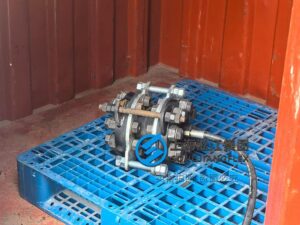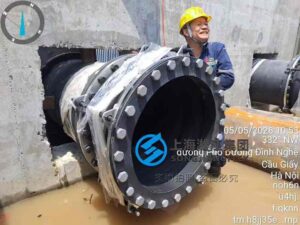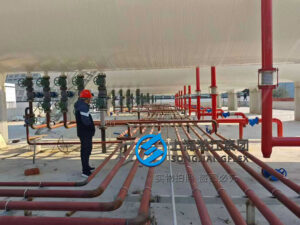
Shanghai Songjiang Shock Absorber Group Co., Ltd. proudly provides high-quality bellows compensators for numerous projects. Below are the installation instructions designed to assist you in proper installation and ensure optimal product performance.
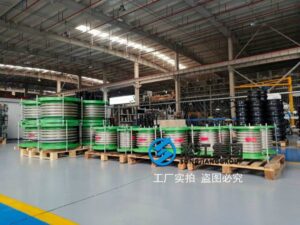
1. Pre-Installation Requirements
-
Model and Specification Verification
Before installation, verify that the bellows compensator model, specifications, and pipeline support configurations comply with design requirements. -
Flow Direction Confirmation
For expansion joints with internal liners, ensure the liner direction aligns with the medium flow direction, following the flow direction mark on the compensator. For planar angular expansion joints, the hinge rotation axis should correspond to the displacement plane. -
Removal of Auxiliary Components
For expansion joints requiring “cold-tightening” pre-deformation, remove auxiliary components used for pre-deformation after completion.
2. Installation Procedures
-
Dimension Adjustment
Adjust the compensator to the specified length using screw nuts before final installation. After installation, remove all auxiliary positioning devices and fasteners used for transport protection. -
Prohibition of Deformation for Alignment
Except for design-specified pre-tensioning or “cold-tightening” pre-deformation, do not use bellows deformation to compensate for pipeline misalignment, as this can reduce compensator lifespan and increase loads on pipelines, equipment, and supports. -
Ensure Freedom of Movement
All moving parts of the compensator must not be restrained or blocked by external structures. -
Protection Against Mechanical Damage
Avoid welding slag or other mechanical damage on the bellows surface during installation.
3. Hydrostatic Test Requirements
-
Support Reinforcement
During hydrostatic testing, reinforce secondary supports at the pipeline ends containing the compensator to prevent movement or rotation. For gas-medium compensators, consider installing temporary supports for the compensator nozzles to bear the weight during water filling. -
Water Quality and Post-Test Handling
Test water must be clean, non-corrosive, and have a chloride ion content below 25 ppm. After testing, promptly drain residual water from the bellows and dry the inner surface of the bellows shell.
4. Additional Installation Notes
-
Pipeline Alignment
Ensure good pipeline alignment. If necessary, install straight pipe sections of equal length before mounting the compensator to maintain alignment. -
No Torsion Allowed
Bellows compensators cannot absorb torsional forces; do not allow torsion during installation. -
Insulation Layer Requirements
Insulation must be applied on the compensator’s protective outer cover, not directly on the bellows, and must exclude chlorine-containing materials. -
Support Installation
Supports must be installed per design before pressure testing; testing before support installation is strictly prohibited to prevent damage. -
Pressure Testing Limits
Pressure tests must not exceed 1.5 times the nominal system pressure. -
Valve Operation
During operation, valves on lines with compensators must be opened and closed gradually to avoid sudden temperature or pressure changes that could damage supports or compensators. -
No Adjustment by Compensator Deformation
Do not use compensator deformation to correct pipeline installation deviations.
For technical support or product consultation, please contact:
Shanghai Songjiang Shock Absorber Group Co., Ltd. – Technical Support Department
📧 Email: [email protected]
🌐 Website: www.shsjflex.com
📱 WhatsApp: +86 13032112360